


Eight Cousins tells the story of orphaned Rose as she settles in a new home with a cluster of opinionated aunts and seven boisterous boy cousins. But while the aunts and cousins give the book its titles, it is Rose's guardian, Uncle Alec, who provides the book's central theme and lessons. Arriving from a sea voyage to find his new charge sick, melancholy and none-the-better for being "pulled to pieces" among her disparate aunts, Dr. Alec commences an experiment. While this virtual manifesto on raising children (especially girls) may seem priggish and overtly didactic today, Dr. Alec implements health and education reforms that were apparently quite outré in the New England high-society that the novel presents.
First reading the novel as an adolescent, I immediately felt at home, not only with its moralizing, but also with its health message. The pronouncements made on subjects varying from coffee to belts were strikingly similar to those made by Seventh-day Adventist pioneer and visionary Ellen White who wrote contemporaneously to Alcott. I now realize that both authors were among a host of voices proposing reforms and that Alcott, at least, would have been strongly influenced by the health reformers of her day. Some of Ellen White's statements on health have been said to be far ahead of any health reformers of her day, but I am aware that virtually all the health reforms here discussed were being advocated by others. I do not have the time or knowledge to provide a substantive history of nineteenth century health reform. But in comparing some of the views of White and Alcott (as expressed by her character Dr. Alec) I hope to show the balance and value of both their contributions to health and dress reform.
Coffee
In Eight Cousins, chapter 3, on the first morning of their acquaintance, Uncle Alec surprises Rose by grabbing her morning dose of strong coffee and pouring it into the garden. "This accounts for the sleepless nights, the flutter your heart gets into at the least start, and this is why that cheek of yours is pale yellow instead of rosy red. No more coffee for you," he declares.
It seems that by the mid-nineteenth century America was on its way to becoming the coffee-driven society it is today. "Coffee drinking expanded rapidly because of the rise of the price of tea during the Revolutionary War years, and also because tea had come to be regarded as not a patriotic drink." (1)
The illnesses Ellen White ascribed to the use of coffee are numerous. One quote will suffice. "Its influence is exciting, and just in the degree that it elevates above par it will exhaust and bring prostration below par. Tea and coffee drinkers carry the marks upon their faces. The skin becomes sallow and assumes a lifeless appearance. The glow of health is not seen upon the countenance." Testimonies to the Church, vol. 2
The Danger of Obedience to Fashion
In Eight Cousins, chapter 5, Dr. Alec notices that Rose's tight, fashionable belt has caused her to pant heavily after a short run around the garden. When unclasped, "the belt flew apart several inches, for it was impossible to restrain the involuntary sigh of relief..." But this is just the first of Uncle Alec's amendments to Rose's dress. Fast-forward to chapter 18 where Aunt Clara attempts to make Rose into a fashion plate.
"The upper skirt [of the suit] was tied so tightly back that it was impossible to take a long step, and the under one was so loaded with plaited frills that it 'wobbled' ungracefully... A bunch of fold was gathered up just below the waist behind, and a great bow rode atop. A small jacket of the same material was adorned with a high ruff at the back, and laid well open over the breast, to display some lace and a locket. Heavy fringes, bows, puffs, ruffles, and revers finished off the dress, making one's head ache to think of the amount of work wasted, for not a single graceful line struck the eye..."
Judging from this description I assume that the fashions described are meant to be the ones in vogue when the book was published, around 1874. "One account reported that the "well-dressed" woman of the late nineteenth century wore 37 pounds of clothing in the winter, 19 which hung from her corseted waist." (Note 2) Here are some images that seemed similar to the description above.


"'Suppose a mad dog or a runaway horse was after you, could you get out of the way without upsetting?' asked the Doctor... Rose made a rush across the room. Her boot-heels caught on the rug, several strings broke, her hat tipped over her eyes, and she plunged promiscuously into a chair... 'I should say that a walking suit in which one could not walk and a winter suit which exposes the throat, head and feet to cold and damp was rather a failure,' said Dr. Alec."
To Alec's ultimate horror, Aunt Clara had surreptitiously brought a corset for Rose to try on. He is hardly being hyperbolic when he indignantly refers to it as an "instrument of torture". Besides inhibiting proper breathing, corsets were sometimes laced so tightly as to cause ribs to puncture lungs, uterine prolapses, miscarriages and increased pain during labor. Here is an illustration of the effect corsets could have on the internal organs after prolonged use.

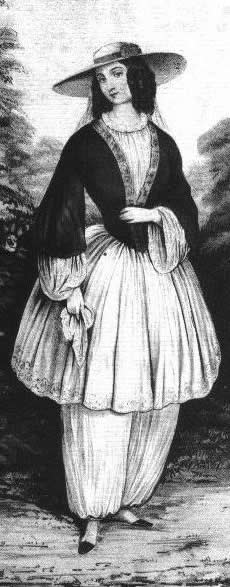
Dress reform, of course, was a large and varied movement in America. The most famous alternate dress was probably the Bloomer, named after Amelia Bloomer. Other reform dresses were not necessarily modifications of the Bloomer, but many seemed to share an Eastern influence. (First is pictured the Bloomer, and then the American Costume.)
But the alternate costume Dr. Alec has prepared for Rose is not a Bloomer, much to Aunt Clara's relief.
It is first and foremost warm and light. "These two suits of flannel... with a skirt or so hung on this easily fitting waist, will keep the child warm... and leave free the muscles that need plenty of room to work in. She shall never have the back-ache if I can help it, nor the long list of ills you dear women think you cannot escape."
As to the dress itself, "there was very little to see, only a pretty Gabrielle dress... coming to the tops of the trim pair of boots with low heels."
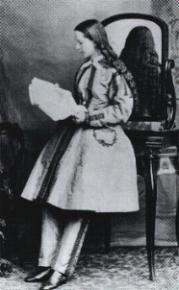
This painting by Whistler is apparently a Gabriel Princess dress. Softly flowing, loose garments such as this were advocated by Pre-Raphaelite painters through the Artistic Dress movement. Of course, to be healthy, sanitary and practical, the dress must end by the top of a woman's boot (which at that time was generally slightly above the ankle).
And now for Ellen White on dress. Her ideas of Christian simplicity, modesty and economy are all inextricably linked in her counsels on dress reform, but it is the effect of dress on health that rings through loudest.
"The form should not be compressed in the least with corsets and whalebones. The dress should be perfectly easy that the lungs and heart may have healthy action. The dress should reach somewhat below the top of the boot, but should be short enough to clear the filth of the sidewalk and street without being raised by the hand. A still shorter dress than this would be proper, convenient, and healthful for women when doing their housework, and especially for those who are obliged to perform more or less out-of-door labor. With this style of dress, one light skirt, or two at most, is all that is necessary, and this should be buttoned on to a waist, or suspended by straps. The hips were not formed to bear heavy weights. The heavy skirts worn by some, and allowed to drag down upon the hips, have been the cause of various diseases which are not easily cured. The sufferers seem to be ignorant of the cause of their sufferings, and continue to violate the laws of their being by girding their waists and wearing heavy skirts, until they are made lifelong invalids. When told of their mistake, many will immediately exclaim, 'Why, such a style of dress would be old-fashioned!' What if it is? I wish we could be old-fashioned in many respects. If we could have the old-fashioned strength that characterized the old-fashioned women of past generations, it would be very desirable. I do not speak unadvisedly when I say that the way in which women clothe themselves, together with their indulgence of appetite, is the greatest cause of their present feeble, diseased condition. There is but one woman in a thousand who clothes her limbs as she should. Whatever may be the length of the dress, their limbs should be clothed as thoroughly as are the men's. This may be done by wearing lined pants, gathered into a band and fastened about the ankle, or made full and tapering at the bottom; and these should come down long enough to meet the shoe. The limbs and ankles thus clothed are protected against a current of air. If the feet and limbs are kept comfortable with warm clothing, the circulation will be equalized, and the blood will remain pure and healthy because it is not chilled or hindered in its natural passage through the system." Selected Messages vol. 2
It is unclear why Alcott presented an alternate dress to the Bloomer or American Costume, but my impression is that it was because the Bloomer and American Costume drew undue attention to the wearer. Ellen White also rejected the American Costume for similar reasons and possibly for its association with spiritualists and radical feminists.

Domestic Learning
"I've been trying to decide what trade I would learn," declares Rose in Eight Cousins chapter 16. "Everyone should have a trade, or something to make a living out of, for rich people may grow poor..."
"There is one very excellent, necessary accomplishment that no girl should be without," replies Dr. Alec, "for it is a help to rich and poor, and the comfort of families depends upon it. [It is] not so romantic, perhaps, as singing, painting, writing, or teaching; but one that makes many happy and comfortable, and home the the sweetest place in the world."
This highly lauded trade, or accomplishment, proves to be housekeeping. Earlier in the novel we learn that “Dr. Alec considered house-work the best sort of gymnastics for girls,” and Ellen White also emphasized the importance of “useful exercise”. (But both authors also encouraged girls to participate in fun outdoor activities, such as skating and sledding so they might enjoy the inestimable benefits of fresh air, exercise and sunlight.)
In The Adventist Home Ellen White's respect for housekeeping sounds strikingly like Dr. Alec's. “A woman who has been taught to take care of herself is also fitted to take care of others. She will never be a drug in the family or in society. When fortune frowns, there will be a place for her somewhere, a place where she can earn an honest living and assist those who are dependent upon her. Woman should be trained to some business whereby she can gain a livelihood if necessary. Passing over other honorable employments, every girl should learn to take charge of the domestic affairs of home, should be a cook, a housekeeper, a seamstress. She should understand all those things which it is necessary that the mistress of a house should know, whether her family are rich or poor. Then, if reverses come, she is prepared for any emergency; she is, in a manner, independent of circumstances.”
Furthermore, Dr. Alec informs Rose, he would rather she "learned how to make good bread than the best pies ever baked. When you bring me a handsome, wholesome loaf, entirely made by yourself, I shall be more pleased than if you offered me a pair of slippers embroidered in the very latest style..."
"Bread-making is an art not easily learned," but when Rose triumphantly bears forth a "nice, round, crusty loaf" Dr. Alec is delighted with her "old-fashioned accomplishment." And so he should be! For according to Ellen White “it is a religious duty for every Christian girl and woman to learn at once to make good, sweet, light bread from unbolted wheat flour. Mothers should take their daughters into the kitchen with them when very young, and teach them the art of cooking. It is sacred duty for those who cook to learn how to prepare healthful food. Many souls are lost as the result of poor cookery. It takes thought and care to make good bread; but there is more religion in a loaf of good bread than many think. There are few really good cooks. Young women think that it is menial to cook and do other kinds of housework; and for this reason, many girls who marry and have the care of families have little idea of the duties devolving upon a wife and mother.” Counsels on Diet and Foods
While the "cult of domesticity" and "the angel of the house" stereotype prescribed women's spheres of action and knowledge, it is also obvious that many young women, whose preordained goal was to marry, had no idea how to care for a family.. Both Alcott and White advocated as much education for girls as for boys, but since, even today, the care of the family falls to the busy-mother, they taught that she should be practically educated in healthful cookery, housekeeping and sewing.
I really can't say I'm convinced that (with the abundance of thrift stores) there's any practical necessity for girls to learn to sew today, but I can say that making our own bread has been an infinite blessing to my family.
Conclusion
There are several other similarities to the counsels of Ellen White in Eight Cousins. Both authors emphasized temperance (as in teetotalism), deplored tobacco, advocated simple diets, free from grease, and taught that all should be thoroughly acquainted with physiology, that they might be the guardians of their own health.
But there are also differences. For example, Bronson Alcott's cousin Dr. William Androus Alcott “insisted on a strict vegetarian diet devoid of coffee, alcohol, or spices.” (1) (I don't know if Louisa ever met him, but it occurred to me that there's a possibility he might have been an inspiration for the character of Dr. Alec.) Louisa's father Bronson advocated vegetarianism and the course, simple diet of Sylvester Graham. However, Louisa's mother sometimes fed her daughters meat and a brief statement in Rose in Bloom, the sequel to Eight Cousins, seems dismissive of vegetarianism as a fad. In contrast, Ellen White was an ardent proponent of vegetarianism.
Perhaps most significant is that Ellen White would likely have rejected this most didactic of Alcott's novels, due to it's very genre. Even novels in which “the author attaches to his story a moral lesson are a curse to the readers,” she opined. (How horrified she would have been by Louisa's "dyspeptic's plumb pudding" thrillers!) But maybe there are exceptions... And probably that's why I felt the pressing need to make these comparisons, just to prove the wholesomeness of this favorite book to a woman who has been dead well-nigh a century.
Congratulations to anyone who has actually read through this post! You're officially amazing! I promise that any thoughts on Rose in Bloom I post will be less quote-heavy.
References:
2. "Women's Roles in the Late 19th Century" by Dorothy W. Hartman


0 comments:
Post a Comment