February Prompt from November's Autumn's Classics Challenge

One of my greatest talents appears to be signing up for blog challenges and not getting around to participating. I'm making my post for the November's Autumn Classics Challenge February Prompt at the very last possible minute. The character I've chosen to write about is Mac Campbell of Louisa May Alcott's two novels Eight Cousins and Rose in Bloom, although I'm only half-way through my reread of the latter right now.

What phrases has the author used to introduce this character?

Here's how Mac is first introduced in Eight Cousins:

Mac shook his hair out of his eyes, stumbled over a stool, and asked abruptly,

“Did you bring any book with you?”

“Four boxes full. They are in the library.”

Mac vanished from the room...


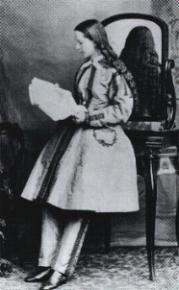
Find a portrait or photograph that closely embodies how you imagine them.

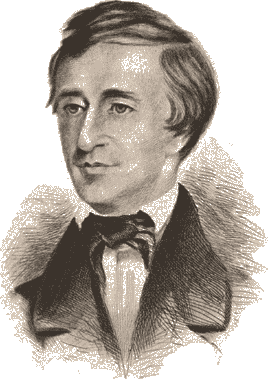
I'm hoping the edition of Rose in Bloom I ordered from the library will have the same illustrations as the one I read at age eight. I really have no idea how to find a portrait that would look like my version of Mac. However, with the novel's strong Transcendentalist theme, a portrait of Henry David Thoreau (before the hideous beard days!) seems appropriate.

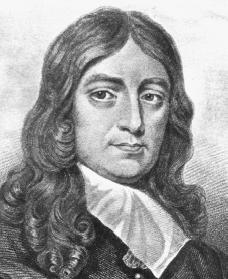
Actually, in my favorite chapter of Rose in Bloom, Rose tells Mac that if he “had no beard and wore [his] hair long” he'd look like Milton. Is it just me, or do Thoreau and Milton look something alike? (Both portraits below are of Milton, of course.)


How has the character changed? Through Eight Cousins and much of Rose in Bloom, Mac is the quintessential nerd. He seems hardly to notice what is going on around him, cares nothing for the society and amusements other people value, and can bury you in an avalanche of erudition. But slowly he begins to observe others, with delightful philosophical amusement, and then to interact more with others in ways that are worth-while and leave his associates better for their contact with him.

Has your opinion of them altered? Since I've reread this novel several times, I guess I can only say my crush on him has grown. ;)

Are there aspects of their character you aspire to? or hope never to be? What are their strengths and faults? Do you find them believable? I'd love to be as erudite as this, "And allophite is the new hydrous silicate of alumina and magnesia, much resembling pseudophite, which Websky found in Silesia." Though I wonder if Alcott just made that up and a real scientist would roar at it. Anyways, it's a delicious sentence.

More seriously, although Mac has faults, I don't think he has any glaring ones that particularly jar on me. They are the rather enduring faults of a nerd – inattention to social etiquette, absorption, and extreme bluntness. In Eight Cousins, as a teenage boy threatened with blindness and kept from the reading he loves, he is fractious and rebellious, but it would be unbelievable to have such a character behave differently. If anything, by the end of Rose in Bloom he has become almost too much a model man to be believable. But I'm certainly not objecting to the strengths that make me admire him. He's intelligent and intellectual, yet has a sense of humor even about himself. He's studying to become a doctor no doubt after Uncle Alec's own heart, whose emphasis is on prevention through healthful, vigorous living. Like a good Transcendentalist, he doesn't just write poetry - his life is a poem. He has, as he has purposed, become a man through "keeping good company, reading good books, loving good things, and cultivating soul and body faithfully and wisely." And did I mention he's hilarious?

Would you want to meet them? Nothing could be more droll! I only hope that I will someday meet someone half so wonderful in “real life”.

Try writing a short (four sentences +) note or letter as the character, addressed to you, another character, the author, anyone.

Dear Cousin,

You asked what else you should read of “my Thoreau”, so I am sending you his account of how he went to the woods to live deliberately. You also asked if all this reading of Keats will not rather put me in danger of catching from him a touch of the romantic as well as Romanticism. Did Archie or Steve never mention that I intend to study love with all the assiduity I have given medicine? But as all the recent contact still hasn't seem to have infected, I think Keats a good primer.

Give my love to my lady Dulcinea and tell Jaime that if he keeps you always running about on his errands that I shall never play base ball with him again.

Your Reluctant Milton

  • Digg
  • Del.icio.us
  • StumbleUpon
  • Reddit
  • RSS

Literary Heroine Blog Party Questionairre

This event looked like fun, so I've dashed off some answers and taken far too much trouble just to find and adjust four pictures.


Introduce yourself! Divulge your life's vision, likes, dislikes, aspirations, or something completely random!

I'm one of the five thousand persons named Sarah who are to be met with everywhere. I'm an only-child, home-schooled and a “great reader” - which translates to being rather misanthropic. I've also grown up in a conservative Christian home, and whether I like it or not, my upbringing sometimes influences my reactions to literature and thus my posts here.

Jane Austen is the delight of my life, but few things make me more angry than people who claim to be fans because of the movie-based image of epic romance, bonnets, balls and lacy frocks.

I hope to take English literature in the next few years, and then become an ivory tower academic. I'll emerge from my tower whenever given an opportunity to sing or listen to Baroque music.

I'm snobbish, pedantic, indolent and ambitious. And perverse, since I'm perversely proud of these ugly traits. (These evil traits are why I need Jane Austen in my life. It just occurred to me that I sound remarkably like Sir Walter Eliot. Hurrah! I'm relieved to finally know what literary character I am most like.)

I'm a verbomaniac, given to sesquipedalianism. I tend to latch on to certain words and over-use them until I've worn them out. Currently, I'm over-using arguably. Well, arguably I'm overusing it. ;)


What, to you, forms the essence of a true heroine?

Are we talking about a heroine to emulate or an unforgettable female protagonist? I won't get analytical about the prerequisites for “heroine status” under either banner. It's hard to emulate a heroine whom we don't feel a connection to, so I have taken some time to think of what some of “my heroines” have in common and why I relate to them:

--Imperfection, faults and even selfishness, but sincerity that leads them to eventually strive to better themselves.

–- Ambition. It doesn't have to be clearly defined or realized, but I don't think I have a favorite heroine who doesn't want to do something great or be recognized and looked up to as somehow remarkable. (And, yes, I know it shows a disturbing tendency in me.)

– Intelligence and bookishness.

– Imagination and a passionate nature.


Share (up to) four heroines of literature that you most admire and relate to.

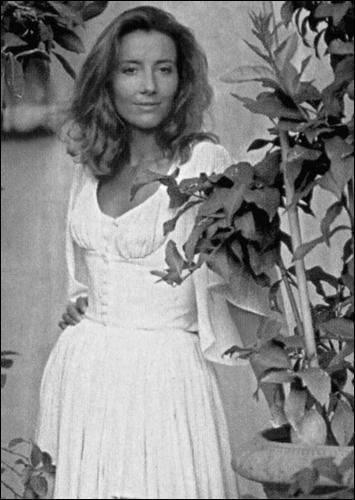
Only four? That is cruel. It is humanly impossible. I inisist upon the perfect number, although that's still leaving out characters I could learn to love equally to those listed here. (I've included pictures only for the first four, since ones I found for the others were too big.)

– Beatrice from Shakespeare's Much Ado About Nothing

She's just so brilliantly witty that I never cease to be delighted by her! (And Emma Thompson played her perfectly.)


--Emma Woodhouse

I love her for her most for the faults we share. “She had always wanted to do everything... but steadiness had always been wanting; and in nothing had she approached the degree of excellence which she would have been glad to command, and ought not to have failed of. She was not much deceived as to her own skill either as an artist or a musician, but she was not unwilling to have others deceived, or sorry to know her reputation for accomplishment often higher than it deserved.”

– Jane Eyre


The novel is the literary love of my life. Poor, plain, obscure and little, Jane reconciles the Christian principle of self-sacrifice with the equally Christian principle that “all ye are brethren”. She keeps to the law given by God, yet rejects the notion that conventionality is morality. She is shockingly passionate and, yes, even sensual, yet follows the guiding of the still small voice of conscience when it costs her everything. In many ways she's my example in navigating seemingly insuperable barriers in my life as a woman and a Christian.

– Anne Shirley

This is the character I've been told most often that I'm like. There's always scope for the imagination with her and she's as funny as they come.

– Dr. Vivian Bearing from Margaret Edson's play W;t

She has a coruscating wit and a formidable intelligence. But she's also prideful, pedantic and without "simple human kindness", until God breaks her apart in order to make her new. I identify with her attempt to hide from others, and even from God, through being "extremely smart". I also identify with her statement: "I always want to know more things."

– Dorothea Brooke, from Middlemarch

I'm nowhere near so unselfish as her, and in some ways identify more with Gwendolen Harleth (of Daniel Deronda) and her ambition to sing, but I identify with Dorothea's yearning for knowledge or “some lofty conception of the world” and her feelings of failure.

– Jo March

She's bookish, intelligent, courageous, passionate, ambitious, funny and entirely her own person. I am inspired by Alcott's models of poor, hard-working heroines, but with Jo I'm always drawn farther into applauding her as she antagonizes high-society and actually seems to grow more eccentric and individualistic with every chapter.

Five of your favorite historical novels?

I assume, from seeing others' answers, that this means novels written in times past, rather than novels about historical figures, like Margaret George's. This list includes several of the novels in which my favorite heroines feature.

The Great Six, ie Jane Austen's works

Jane Eyre

Middlemarch

By Far Euphrates by Deborah Alcock (I had to throw in something less well-known here.)

The Pilgrim's Progress (arguably not a novel, but not exactly non-fiction either)


Out of those five books who is your favorite main character and why?

I believe I've already answered that above, though Elizabeth Bennet and all Jane Austen's heroines deserve mentions too.

Out of those five books who is your favorite secondary character and why?

Arguably, Dr. Lydgate is as much the hero of Middlemarch as Dorothea is the heroine, but I'll say him. I also have a tendency to sympathy with generally disliked lesser characters, such St. John, Mary Bennet or even Blanche Ingram.

If you were to plan out your dream vacation, where would you travel to - and what would you plan to do there?

For something closer to home I'd go to The Island (Prince Edward Island, of course -is there any other island?) and try to catch some of the magic that Lucy Maud Montgomery spun around it.

My other dream vacation would be to England and Scotland, where I'd have to stay for months to see half the historic and literary sites I'm enamored of.

What is your favorite time period and culture to read about?

I should have been born sometime during the Renaissance, before 1500, and lived several decades into the 20th century, since I'm obsessed with everything between those times.

You have been invited to perform at the local charity concert. Singing, comedy, recitation - what is your act comprised of?

It would be a waste of three years of voice lessons if I didn't sing, but (Emma that I am) I also have a propensity to the other two. I adore sketch comedy and I'd probably imbue it with less of my angst about needing to sing. I also love accents and long poems (especially dramatic monologues) so recitation would be appropriate too, if anyone would have the patience to listen in this modern age.

If you were to attend a party where each guest was to portray a heroine of literature, who would you select to represent?

Anne Shirley would be very recognizable and fun. I've also wished for red hair with something of Anne's yearning for raven black hair a while now.

What are your sentiments on the subject of chocolate?

It is a pernicious and deleterious substance, which I indulge in only occasionally, when a guest in the home of someone obviously trying to poison me with it.


Favorite author(s)?

Jane Austen

Louisa May Alcott

Lucy Maud Montgomery

Charlotte Bronte

Elizabeth Gaskell

George Eliot

Emily Dickinson

Deborah Alcock

Charles Dickens

John Donne

John Milton

William Wordsworth

Robert Browning

Elizabeth Barrett Browning

Christian Rossetti

Sam Campbell

(To name a few)


Besides essentials, what would you take on a visiting voyage to a foreign land?

Books by favorite authors from that country and maybe my violin.

In which century were most of the books you read written?

The nineteenth.

In your opinion, the ultimate hero in literature is…

Again, is this about the most admirable or the one I adore most?

I'm going to be writing a post about how much I love and admire Mac in Louisa May Alcott's Rose in Bloom soon. But Mr. Rochester is the character who spoiled me for all other men, when I first “met” him at age fourteen. Where else will I find a hero that talks like a Sphinx?

Describe your ideal dwelling place.

Bright with large windows and ceilings, floors or walls of a golden wood. It must either have a library or be lined bookshelves. It doesn't have to be new or big, but a truly “ideal” place would have the uniqueness, charm and piquancy of a home from L.M. Montgomery's novels – a dormer window, or gables, or a bed you have to use a stool to get into, or something of that sort.

Sum up your fashion style in five words.

Comfortable, modest, matching, inexpensive, colorful. Actually, here's another way I tend to identify with Dorothea: “To her the destinies of mankind, seen by the light of Christianity, made the solicitudes of feminine fashion appear an occupation for Bedlam.” And yet at the same time I'll passionately argue against men who set out countless guidelines on what women should wear, under the guise of Christianity.

Have you ever wanted to change a character’s name?

I have the dreadful confession to make that while I'm now used to Elizabeth Bennet's 'nicknames', I understand why Little Elizabeth in L.M. Montgomery's Anne of Windy Willows says, "I never can feel like Lizzie."

"Who could?" Anne replied.

In your opinion, the most dastardly villain of all literature is...

Have I ever mentioned that I abhor the seemingly innocuous Mr. Skimpole? (See my Dickens' birthday post) To me he's far more upsetting than characters who soon show their true colors in blood, gore and wailing, like Goneril and Regan.

Three favorite Non-fiction books?

Again, how cruel to limit. Today I'll go with:

The King James Bible

Singer on the Sand by Norma Youngberg

Paradise Lost by John Milton (arguably non-fiction, eh?)

Your duties met for the day, how would you choose to spend a carefree summer afternoon?

I'd tramp the woods and fields with my dog for a while, lie in a hammock and read, and have some friends over and sing everything from oratorios to funny nineteenth-century American temperance songs.

Create a verbal sketch of your dream hat - in such a way as will best portray your true character.

A large straw hat to protect my light skin from the sun, with a ribbon to tie it on, since I love running in the wind. The ribbon must not be too “girly” either – green would be nice. Yeah, I'd have the Anne braids too.

Share the most significant event(s) that have marked your life in the past year.

That would probably be the death of friend, neighbor and church-member Karen, after a heroic battle with cancer. Watching her family struggle since then has marked the year too.

Share the Bible passage(s) that have been most inspiring to you recently.

Usually when asked for a favorite Bible text I play perverse and respond with something delightful like, “Curse ye Meroz... curse ye bitterly the inhabitants thereof...” However, like any not-so-good Christian, I have scores of favorite passages. The one I'm sharing here struck me recently with its incredible sublimity and its expression of the central truth of Christianity: “That in all things He might have the preeminence.”


Strengthened with all might, according to his glorious power, unto all patience and longsuffering with joyfulness;

Giving thanks unto the Father, which hath made us meet to be partakers of the inheritance of the saints in light:

Who hath delivered us from the power of darkness, and hath translated us into the kingdom of his dear Son:

In whom we have redemption through his blood, even the forgiveness of sins:

Who is the image of the invisible God, the firstborn of every creature:

For by him were all things created, that are in heaven, and that are in earth, visible and invisible, whether they be thrones, or dominions, or principalities, or powers: all things were created by him, and for him:

And he is before all things, and by him all things consist.

And he is the head of the body, the church: who is the beginning, the firstborn from the dead; that in all things he might have the preeminence.

For it pleased the Father that in him should all fulness dwell;

And, having made peace through the blood of his cross, by him to reconcile all things unto himself; by him, I say, whether they be things in earth, or things in heaven.

And you, that were sometime alienated and enemies in your mind by wicked works, yet now hath he reconciled

In the body of his flesh through death, to present you holy and unblameable and unreproveable in his sight:

If ye continue in the faith grounded and settled, and be not moved away from the hope of the gospel, which ye have heard, and which was preached to every creature which is under heaven

Colossians 1: 11-23


(I really couldn't settle on any less. I actually love Paul's inability to put a period where he doesn't absolutely have to!)


  • Digg
  • Del.icio.us
  • StumbleUpon
  • Reddit
  • RSS

Factions Within the Janeite Denomination: To Which Do You Belong?

"Like all regular churchgoers, he [the Jane Austenite] scarcely notices what is being said.” - E.M. Forster

“Jane Austen is weirdly capable of keeping everybody busy. The moralists, the Eros-and-Agape people, the Marxists, the Freudians, the Jungians, the semioticians, the deconstructors – all find an adventure playground in six samey novels about middle-class provincials.” -Martin Amis

It has been pointed out before that while other authors have fans, Jane Austen has devotees and disciples who seem to orient their whole lives around her. The cult of Jane Austen is so large and devoted that it may almost be called a religion. The followers of the religion have a name derived from hers – Janeites. The good Janeite reads and rereads her works, always loving them more. He or she is not content with merely the six novels, but reads Austen's juvenilia and letters with an admiration seldom given to an author's “minor” works. There's even a Janeite church - The Jane Austen Society (most notably the JA Society of North America – JASNA) which hosts regular meetings which are attended with all the respect, and more excitement, than a regular church service. At these meetings attendees sit on the edge of their seats to learn more about what Jane ate or hear yet another defense of Fanny Price.

There's also a church periodical, Persuasions, in which The Inspired Writings are poured over with greater fascination, but no less urgency and detail, than any theologian or textual critic ever gives the Bible.

Janeites read books about Jane and her characters, watch every film adaptation and spin-off, consider Jane's hypothetical approval the highest accolade and are never ashamed to confess before men that she of the finely-manicured lawns and ceaseless country dances is their favorite author.

But, like any religion, Janeism has its factions. And, as with the factions in any religion, those on one side will sometimes look at those on the other and say, “How on earth can you be a Janeite and believe that?”

It's a good thing that Janeism isn't actually an organized religion or denomination. Just imagine the headlines:

Janeites About to Split Over the Validity of Austen-Leigh's Biography!

Wollstonecraft Society Issues Invitation to Disaffected “Janeite sisters”.

Scandal rocks Janeism as famous lecturer declares she “hates” Fanny Price!

Life as a Janeite: Confessions of a Woman Raised in the Cult Founded in 1811 by English Spinster Jane Austen

Janeites to Debate Mary Worship: Should Mary Bennet and Mary Crawford be inducted into the Janeite pantheon of heroines?

More Mary Worship: Should Janeites be required to swear loyalty to Mary, Queen of Scots?

(I'd love to hear more headlines, if my readers would like to think of any!)

Well, enough silliness. On to something like sense. I've been browsing Natalie Tyler's The Friendly Jane Austen and one of the first sections is “How Do We Love Jane Austen? Let Us Count the Ways”. It contains a self-evaluation quiz, which I couldn't do properly, having never seen a Meg Ryan movie to choose as a favorite and not having a favorite Beatle either. (I.e., I thought the quiz a paragon of Silly.) And I don't entirely agree with its description of Janeite "schools", but I'll list them as in the book and then give my own thoughts.

Are You A Janeite?

The first school, the Janeites, proposes that Jane (and if you are a Janeite, you are on a comfortable first-name standing with your favorite author) provides an alternate, romantic reality more attractive than real life with its wars and deaths. This school, alternatively, can be regarded as Jane as comfort food, Jane as a pint of Ben & Jerry's ice cream or a Kraft macaroni and cheese dinner on a stormy night. Your Jane is a teller of fairy tales in which Cinderella always claims the prince in a sweetly satisfying, and never syrupy, idyll.

The book then quotes E.M. Forster as “A Janeite Par Excellence”: “I am a Jane Austenite, and therefore slightly imbecile about Jane Austen... I read and re-read, the mouth open and the mind closed...”


Do You Belong To The School Of Gentle Jane?

The second school consists of the students of Gentle Jane. These readers believe that Jane Austen depicts an ideal society in which goodness is always rewarded and a divine harmony shapes our ends. Jane Austen's novels can teach us how to become ladies and gentlemen, how to avoid vulgarity, how to conduct ourselves with civility. Jane Austen is not merely a beloved escape and consolation, but one who represents an attainable reality of a pleasantly well-ordered life. She is like a beloved aunt always providing the best and wisest counsel.”

The book then quotes C.S. Lewis' wonderful essay ("A Note on Jane Austen") in which he talks of “the great abstract nouns of the classical English moralists” as the “concepts by which Jane Austen grasps the world.”


Do You Belong to the Ironic Jane School?

The third school of Austen lover contends that Jane's muse is neither high romance nor the ideal of civility, but rather irony. This Jane Austen is brilliantly terrifying in her acerbic, quietly vitriolic observations about the human character. She is the one person whose insights about yourself you would most fear because you realize that her perceptions are penetratingly perspicacious, and piercingly accurate. This school loves Jane Austen because she has honed their intellectual judgments and intensified their irony quotients and, most of all, because she makes them chortle. If you laugh out loud or even chuckle softly to yourself when you hear the words 'Maple Grove,' 'Mr. Suckling,' 'rears and vices,' or 'pollute the shades,' you are probably already a thoroughgoing ironist who reads Jane Austen more for delight than for inspiration or instruction, although you would not be likely to deny that inspiration and instruction are abundant.”

The book then quotes Claire Tomalin as “The Voice of the Ironic Jane School”: “Her sharpness and refusal to suffer fools makes you fearful of intruding, misinterpreting, crassly misreading the evidence.”


Do You Belong To The Subversive Jane School?

Finally, the fourth major Austen Academy consists of those who see Jane Austen as a protofeminist whose prime interest was in ameliorating the lot of women. Her very real transgressive and subversive messages may be read between the lines of her parodic novels. Her novels are imbued with feminist commentary; she is the mother of upward mobility for women and the author of some of the first adventure stories for young ladies. Behind a veneer of civility lurks a deep anger that most women do not have the luxury of refusing to become chattel, and while England celebrates its navy and its clergymen, the wives, mothers, and sisters who are the backbone of the system are given only perfunctory public notice. Your Jane Austen exposes the injustice of this society. Furthermore, she made enormous strides in the art of the narration of the novel. She was an innovator, ahead of her time in every way. You are intrigued by articles on covert lesbianism, or masturbation fantasy, or indirect critique of the Napoleonic Wars in Austen's novels and think that they explore a major layer of meaning.”

Jan Fergus is then quoted as a Subversive Janeite, saying, “Acutely conscious of other women's writing, of women's subordinate and marginal position within society, Austen began by writing burlesques that offer comic images of female power and possibility. Her unconventional portraits of women in the juvenilia reflects her skepticism about contemporary notions of what women were like – and what they should be like... In her later novels, she managed to convey an increasing sense of women's insecure and even threatened position within their social worlds, without destroying a comic tone.”


My Thoughts Which I Trust Will Go Down With All The Eclat of a Proverb

Ooookay... First, I disagree with calling the first class merely Janeites, since I think that's a term that is now used to embrace all devotees of the great lady. Alternate names I'd give this school might be Romantic Jane, Escapist Jane or Chick-lit Jane. (Personally, this is the 'school' that gets my ire up the most. Austen's works are classics for a reason – they're ferociously intelligent, expertly crafted and endlessly deconstruct-able. If you want to drool over handsome men in cravats and magnificent houses there are plenty of cheap romance novels available. Just don't touch my Jane with a ten foot pole!)

Secondly, I find applying the term Gentle Jane to the persona of the “Jane as Great Moralist” school a reductive misrepresentation. I think that authors like C.S. Lewis or Sarah Emsley, who have argued for Jane Austen as a Christian moralist, are well aware that Jane Austen did not create a world in which “goodness is always rewarded” and that she was not proposing that doing right will always produce perfect “harmony”. They are aware of Austen's irony and C.S. Lewis wrote that “the hard core of morality and even of religion seems to me to be just what makes good comedy possible.” Certainly Jane Austen has been sometimes wrongly eulogized as “our dear, everybody's dear Jane”. But I believe an understanding of Jane Austen's moral basis does not mean we must devolve into tea-sipping reminiscers on how good is was in “dear Aunt Jane's day.” Again, as C.S. Lewis has mentioned in his wonderful essay, the emphasis on morality is actually “hard” and “the hardness, is, of course, for oneself, not for one's neighbors”. Our dear Aunt Jane is as faithful a friend as Mr. Knightley in pointing out our faults and our sins. (Nor, in my mind, does the idea of Jane Austen as moralist mean we have to ignore that she herself may have had a “war in her members” between the acerbity of her wit and her “notion of Christian forgiveness”.)

Thirdly, I question how anyone can be a Janeite of any “school” without recognizing and appreciating her pervading irony. Just as L.M. Montgomery once said, “Robert Browning hurts me worse than any poet – and so I love him most,” I might say, “Jane Austen frightens me more than any other writer, and therefore I love her most”. I agree with Claire Tomalin's conclusion that reading Jane Austen is a dangerous thing, because she may well be laughing at the conclusions she is leading us to draw. But even while reading Austen is a frightening and dangerous experience, it's ultimately a hilarious one. An online-friend of mine once said that she was convinced that if Jane Austen lived today she'd be a comedian. I'm not sure I agree, because to me the essence of Jane Austen's irony is its layers. Maybe the surface statement is true on a level, and maybe the exact opposite is what Austen was trying to get across, but every time you read the text you'll discover a new layer. And to me that's something that is best achieved through the written text.

Sixth and lastly”, I actually think Subversive Janeism is described quite accurately! A shorter description might be in Karen Joy Fowler's words about her character Allegra in The Jane Austen Book Club, “If Allegra worked in a bookstore she would have shelved Jane Austen in the horror section.” (Quoting from memory, not verbatim.) A notable Subversive Janeite on the blogosphere is Arnie Perlstein with his theories about the dangers of pregnancy and childbirth as pervading in the novels. While I remain unconvinced by the more radical theses of proponents of this school, I respect that they bring to light Jane Austen's intelligent awareness of the events and ideas of her day.

I have many favorite authors and many of them help form my philosophy of life and cheer me in times of depression and discouragement. But it recently occurred to me that if I was allowed to read only one author for an extended period of time, it would be Jane Austen. Not because of the romance, not because of the critical and historical treasure-troves, and not even because of the acutely-developed moral sense. All these are a part of “my” Jane Austen's glory, but it is her humor that could keep me going through anything. As long as Jane Austen is around to remind me to laugh at life, my neighbors, and myself, I know things will ultimately come out okay. Probably not in a “fairy-tale” ending like in one of her novels, but at least with the sound of laughter.

I've also been thinking about Beatrice in Shakespeare's Much Ado About Nothing. Elizabeth and Darcy have been compared to Beatrice and Benedick since P&P was first published. But it seems to me that Jane Austen herself was as much Beatrice as anyone ever has been; “there's little of the melancholy element in her... she hath often dreamed of unhappiness and waked herself with laughing.” Perhaps in the hour Jane Austen was born her mother cried from the curse of child-birth and perhaps this Beatrice never found a Benedictus potent enough to sacrifice her writing for. But what I do positively know is that December 16, 1775 there was a star danced, and under that star was Jane Austen born.

And to conclude (with Dogberry) I'll be posting a poll in the sidebar so I can discover what kind of Janeites are visiting my blog. Please vote! (You may vote for several options.)


  • Digg
  • Del.icio.us
  • StumbleUpon
  • Reddit
  • RSS

Louisa, meet Ellen: A Comparison of Two Nineteenth Century American Writers on Health

I've been enjoying rereading Louisa May Alcott's children's novel Eight Cousins (or The Aunt-Hill) with Susan Bailey's book club at her blog called Louisa May Alcott is my Passion.


Eight Cousins tells the story of orphaned Rose as she settles in a new home with a cluster of opinionated aunts and seven boisterous boy cousins. But while the aunts and cousins give the book its titles, it is Rose's guardian, Uncle Alec, who provides the book's central theme and lessons. Arriving from a sea voyage to find his new charge sick, melancholy and none-the-better for being "pulled to pieces" among her disparate aunts, Dr. Alec commences an experiment. While this virtual manifesto on raising children (especially girls) may seem priggish and overtly didactic today, Dr. Alec implements health and education reforms that were apparently quite outré in the New England high-society that the novel presents.

First reading the novel as an adolescent, I immediately felt at home, not only with its moralizing, but also with its health message. The pronouncements made on subjects varying from coffee to belts were strikingly similar to those made by Seventh-day Adventist pioneer and visionary Ellen White who wrote contemporaneously to Alcott. I now realize that both authors were among a host of voices proposing reforms and that Alcott, at least, would have been strongly influenced by the health reformers of her day. Some of Ellen White's statements on health have been said to be far ahead of any health reformers of her day, but I am aware that virtually all the health reforms here discussed were being advocated by others. I do not have the time or knowledge to provide a substantive history of nineteenth century health reform. But in comparing some of the views of White and Alcott (as expressed by her character Dr. Alec) I hope to show the balance and value of both their contributions to health and dress reform.


Coffee


In Eight Cousins, chapter 3, on the first morning of their acquaintance, Uncle Alec surprises Rose by grabbing her morning dose of strong coffee and pouring it into the garden. "This accounts for the sleepless nights, the flutter your heart gets into at the least start, and this is why that cheek of yours is pale yellow instead of rosy red. No more coffee for you," he declares.

It seems that by the mid-nineteenth century America was on its way to becoming the coffee-driven society it is today. "Coffee drinking expanded rapidly because of the rise of the price of tea during the Revolutionary War years, and also because tea had come to be regarded as not a patriotic drink." (1)

The illnesses Ellen White ascribed to the use of coffee are numerous. One quote will suffice. "Its influence is exciting, and just in the degree that it elevates above par it will exhaust and bring prostration below par. Tea and coffee drinkers carry the marks upon their faces. The skin becomes sallow and assumes a lifeless appearance. The glow of health is not seen upon the countenance." Testimonies to the Church, vol. 2


The Danger of Obedience to Fashion


In Eight Cousins, chapter 5, Dr. Alec notices that Rose's tight, fashionable belt has caused her to pant heavily after a short run around the garden. When unclasped, "the belt flew apart several inches, for it was impossible to restrain the involuntary sigh of relief..." But this is just the first of Uncle Alec's amendments to Rose's dress. Fast-forward to chapter 18 where Aunt Clara attempts to make Rose into a fashion plate.

"The upper skirt [of the suit] was tied so tightly back that it was impossible to take a long step, and the under one was so loaded with plaited frills that it 'wobbled' ungracefully... A bunch of fold was gathered up just below the waist behind, and a great bow rode atop. A small jacket of the same material was adorned with a high ruff at the back, and laid well open over the breast, to display some lace and a locket. Heavy fringes, bows, puffs, ruffles, and revers finished off the dress, making one's head ache to think of the amount of work wasted, for not a single graceful line struck the eye..."

Judging from this description I assume that the fashions described are meant to be the ones in vogue when the book was published, around 1874. "One account reported that the "well-dressed" woman of the late nineteenth century wore 37 pounds of clothing in the winter, 19 which hung from her corseted waist." (Note 2) Here are some images that seemed similar to the description above.


"'Suppose a mad dog or a runaway horse was after you, could you get out of the way without upsetting?' asked the Doctor... Rose made a rush across the room. Her boot-heels caught on the rug, several strings broke, her hat tipped over her eyes, and she plunged promiscuously into a chair... 'I should say that a walking suit in which one could not walk and a winter suit which exposes the throat, head and feet to cold and damp was rather a failure,' said Dr. Alec."

To Alec's ultimate horror, Aunt Clara had surreptitiously brought a corset for Rose to try on. He is hardly being hyperbolic when he indignantly refers to it as an "instrument of torture". Besides inhibiting proper breathing, corsets were sometimes laced so tightly as to cause ribs to puncture lungs, uterine prolapses, miscarriages and increased pain during labor. Here is an illustration of the effect corsets could have on the internal organs after prolonged use.


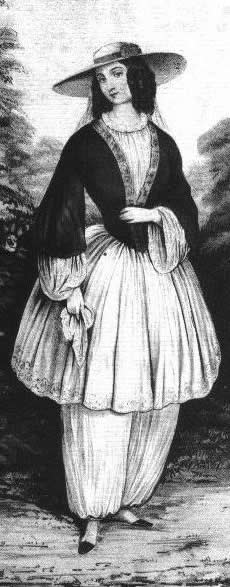
Dress reform, of course, was a large and varied movement in America. The most famous alternate dress was probably the Bloomer, named after Amelia Bloomer. Other reform dresses were not necessarily modifications of the Bloomer, but many seemed to share an Eastern influence. (First is pictured the Bloomer, and then the American Costume.)


But the alternate costume Dr. Alec has prepared for Rose is not a Bloomer, much to Aunt Clara's relief.

It is first and foremost warm and light. "These two suits of flannel... with a skirt or so hung on this easily fitting waist, will keep the child warm... and leave free the muscles that need plenty of room to work in. She shall never have the back-ache if I can help it, nor the long list of ills you dear women think you cannot escape."

As to the dress itself, "there was very little to see, only a pretty Gabrielle dress... coming to the tops of the trim pair of boots with low heels."


This painting by Whistler is apparently a Gabriel Princess dress. Softly flowing, loose garments such as this were advocated by Pre-Raphaelite painters through the Artistic Dress movement. Of course, to be healthy, sanitary and practical, the dress must end by the top of a woman's boot (which at that time was generally slightly above the ankle).

And now for Ellen White on dress. Her ideas of Christian simplicity, modesty and economy are all inextricably linked in her counsels on dress reform, but it is the effect of dress on health that rings through loudest.

"The form should not be compressed in the least with corsets and whalebones. The dress should be perfectly easy that the lungs and heart may have healthy action. The dress should reach somewhat below the top of the boot, but should be short enough to clear the filth of the sidewalk and street without being raised by the hand. A still shorter dress than this would be proper, convenient, and healthful for women when doing their housework, and especially for those who are obliged to perform more or less out-of-door labor. With this style of dress, one light skirt, or two at most, is all that is necessary, and this should be buttoned on to a waist, or suspended by straps. The hips were not formed to bear heavy weights. The heavy skirts worn by some, and allowed to drag down upon the hips, have been the cause of various diseases which are not easily cured. The sufferers seem to be ignorant of the cause of their sufferings, and continue to violate the laws of their being by girding their waists and wearing heavy skirts, until they are made lifelong invalids. When told of their mistake, many will immediately exclaim, 'Why, such a style of dress would be old-fashioned!' What if it is? I wish we could be old-fashioned in many respects. If we could have the old-fashioned strength that characterized the old-fashioned women of past generations, it would be very desirable. I do not speak unadvisedly when I say that the way in which women clothe themselves, together with their indulgence of appetite, is the greatest cause of their present feeble, diseased condition. There is but one woman in a thousand who clothes her limbs as she should. Whatever may be the length of the dress, their limbs should be clothed as thoroughly as are the men's. This may be done by wearing lined pants, gathered into a band and fastened about the ankle, or made full and tapering at the bottom; and these should come down long enough to meet the shoe. The limbs and ankles thus clothed are protected against a current of air. If the feet and limbs are kept comfortable with warm clothing, the circulation will be equalized, and the blood will remain pure and healthy because it is not chilled or hindered in its natural passage through the system." Selected Messages vol. 2

It is unclear why Alcott presented an alternate dress to the Bloomer or American Costume, but my impression is that it was because the Bloomer and American Costume drew undue attention to the wearer. Ellen White also rejected the American Costume for similar reasons and possibly for its association with spiritualists and radical feminists.

Domestic Learning

"I've been trying to decide what trade I would learn," declares Rose in Eight Cousins chapter 16. "Everyone should have a trade, or something to make a living out of, for rich people may grow poor..."

"There is one very excellent, necessary accomplishment that no girl should be without," replies Dr. Alec, "for it is a help to rich and poor, and the comfort of families depends upon it. [It is] not so romantic, perhaps, as singing, painting, writing, or teaching; but one that makes many happy and comfortable, and home the the sweetest place in the world."

This highly lauded trade, or accomplishment, proves to be housekeeping. Earlier in the novel we learn that “Dr. Alec considered house-work the best sort of gymnastics for girls,” and Ellen White also emphasized the importance of “useful exercise”. (But both authors also encouraged girls to participate in fun outdoor activities, such as skating and sledding so they might enjoy the inestimable benefits of fresh air, exercise and sunlight.)

In The Adventist Home Ellen White's respect for housekeeping sounds strikingly like Dr. Alec's. “A woman who has been taught to take care of herself is also fitted to take care of others. She will never be a drug in the family or in society. When fortune frowns, there will be a place for her somewhere, a place where she can earn an honest living and assist those who are dependent upon her. Woman should be trained to some business whereby she can gain a livelihood if necessary. Passing over other honorable employments, every girl should learn to take charge of the domestic affairs of home, should be a cook, a housekeeper, a seamstress. She should understand all those things which it is necessary that the mistress of a house should know, whether her family are rich or poor. Then, if reverses come, she is prepared for any emergency; she is, in a manner, independent of circumstances.”

Furthermore, Dr. Alec informs Rose, he would rather she "learned how to make good bread than the best pies ever baked. When you bring me a handsome, wholesome loaf, entirely made by yourself, I shall be more pleased than if you offered me a pair of slippers embroidered in the very latest style..."

"Bread-making is an art not easily learned," but when Rose triumphantly bears forth a "nice, round, crusty loaf" Dr. Alec is delighted with her "old-fashioned accomplishment." And so he should be! For according to Ellen White “it is a religious duty for every Christian girl and woman to learn at once to make good, sweet, light bread from unbolted wheat flour. Mothers should take their daughters into the kitchen with them when very young, and teach them the art of cooking. It is sacred duty for those who cook to learn how to prepare healthful food. Many souls are lost as the result of poor cookery. It takes thought and care to make good bread; but there is more religion in a loaf of good bread than many think. There are few really good cooks. Young women think that it is menial to cook and do other kinds of housework; and for this reason, many girls who marry and have the care of families have little idea of the duties devolving upon a wife and mother.” Counsels on Diet and Foods

While the "cult of domesticity" and "the angel of the house" stereotype prescribed women's spheres of action and knowledge, it is also obvious that many young women, whose preordained goal was to marry, had no idea how to care for a family.. Both Alcott and White advocated as much education for girls as for boys, but since, even today, the care of the family falls to the busy-mother, they taught that she should be practically educated in healthful cookery, housekeeping and sewing.

I really can't say I'm convinced that (with the abundance of thrift stores) there's any practical necessity for girls to learn to sew today, but I can say that making our own bread has been an infinite blessing to my family.


Conclusion


There are several other similarities to the counsels of Ellen White in Eight Cousins. Both authors emphasized temperance (as in teetotalism), deplored tobacco, advocated simple diets, free from grease, and taught that all should be thoroughly acquainted with physiology, that they might be the guardians of their own health.

But there are also differences. For example, Bronson Alcott's cousin Dr. William Androus Alcott “insisted on a strict vegetarian diet devoid of coffee, alcohol, or spices.” (1) (I don't know if Louisa ever met him, but it occurred to me that there's a possibility he might have been an inspiration for the character of Dr. Alec.) Louisa's father Bronson advocated vegetarianism and the course, simple diet of Sylvester Graham. However, Louisa's mother sometimes fed her daughters meat and a brief statement in Rose in Bloom, the sequel to Eight Cousins, seems dismissive of vegetarianism as a fad. In contrast, Ellen White was an ardent proponent of vegetarianism.

Perhaps most significant is that Ellen White would likely have rejected this most didactic of Alcott's novels, due to it's very genre. Even novels in which “the author attaches to his story a moral lesson are a curse to the readers,” she opined. (How horrified she would have been by Louisa's "dyspeptic's plumb pudding" thrillers!) But maybe there are exceptions... And probably that's why I felt the pressing need to make these comparisons, just to prove the wholesomeness of this favorite book to a woman who has been dead well-nigh a century.

Congratulations to anyone who has actually read through this post! You're officially amazing! I promise that any thoughts on Rose in Bloom I post will be less quote-heavy.

References:

1. "Popular Health Movements and Diet Reform in Nineteenth-Century America" by Nanami Suzuki, published in The Japanese Journal of American Studies, No. 21 (2010)

2.
"Women's Roles in the Late 19th Century" by Dorothy W. Hartman

  • Digg
  • Del.icio.us
  • StumbleUpon
  • Reddit
  • RSS

Happy Birthday, Mr. Dickens! Will you help me skin Mr. Skimpole?

The literary world is alive today with the jollity of Charles Dickens' 200th birthday. For my own small part in the celebration, I've done this questionnaire from Miss Laurie of Old-Fashioned Charm .

How were you first introduced to Charles Dickens?

Well, it feels like I've always been aware of his existence. I think I first picked up A Tale of Two Cities at fourteen, but got distracted and didn't finish it. Blush Frankly, Dickens used to scare me. Maybe it was because of the myth that he was paid by the word, maybe it was because he seems more a caricaturist than Victorian female novelists. But when I actually got to reading Dickens I thoroughly enjoyed him. Still, I'm a neophyte.

Which Charles Dickens novels and stories have you read? Which are your favorites?

Only Bleak House and A Christmas Carol. They're both favorites. Although I focus more on BH in these questions, I adore the ebullience of A Christmas Carol .

Which Charles Dickens novel(s) do you most want to read?

I'm currently reading The Pickwick Papers (and loving it!) and have Great Expectations on order at the library. Some others that rank as high priorities are:

    Little Dorrit

    David Copperfield

    The Old Curiosity Shop

    Oliver Twist

    A Tale of Two Cities

What are your favorite Charles Dickens quotes (up to three)?
Only two off the top of my head: "It was the best of times, it was the worst of times, it was the age of wisdom, it was the age of foolishness, it was the epoch of belief, it was the epoch of incredulity, it was the season of Light, it was the season of Darkness, it was the spring of hope, it was the winter of despair, we had everything before us, we had nothing before us, we were all going direct to Heaven, we were all going direct the other way--in short, the period was so far like the present period, that some of its noisiest authorities insisted on its being received, for good or for evil, in the superlative degree of comparison only."


And this next one is because of Jim Carter's sonorous reading in Cranford of a passage that is so utterly Dickensian. (Surprise!)

In came a fiddler with a music-book, and went up to the lofty desk, and made an orchestra of it, and tuned like fifty stomach-aches. In came Mrs Fezziwig, one vast substantial smile. In came the three Miss Fezziwigs, beaming and lovable. In came the six young followers whose hearts they broke. In came all the young men and women employed in the business. In came the housemaid, with her cousin, the baker. In came the cook, with her brother’s particular friend, the milkman. In came the boy from over the way, who was suspected of not having board enough from his master; trying to hide himself behind the girl from next door but one, who was proved to have had her ears pulled by her mistress. In they all came, one after nother; some shyly, some boldly, some gracefully, some awkwardly, some pushing, some pulling; in they all came, anyhow and everyhow. Away they all went, twenty couple at once; hands half round and back again the other way; down the middle and up again; round and round in various stages of affectionate grouping; old top couple always turning up in the wrong place; new top couple starting off again, as soon as they got there; all top couples at last, and not a bottom one to help them...”

Who are your Top 3 favorite Dickens heroines? and why?

I've heard Dickens accused of not creating realistic female characters – either angels of the house or madwomen. I haven't read enough Dickens to express a definite opinion, but I guess I've only got two favorite heroines, both from Bleak House. Lady Dedlock, because she is not angelic and because she has become trapped and chained by circumstances; she's real and interesting. And her housekeeper, Mrs. Rouncewell, for her ordinary heroism and love for her “failed” son.

Who are your Top 3 favorite Dickens heroes? and why?

Ebenezer Scrooge, for what he becomes and all that jolly shouting out of windows on Christmas morning. Apparently Nabokov called John Jarndyce “the best and kindest man ever to appear in a novel” and I certainly liked him, though I find that declaration too full of superlatives. And speaking of superlatives, Boythorne is a welcome alternative to Skimpole.

Which three Dickens villains do you most love to hate?

While my blood pressure sky-rockets out of the stratosphere at the mere mention of his name, I rejoice at this opportunity to declare my eternal hatred for Harold Skimpole! Every time I think of hating literary characters, I'm reminded of my great desire to slowly skin Mr. Skimpole. Why? Maybe it's because I know people who have a touch of his cheerful, impractical inefecutalness. Maybe it's because under the unceasing innocence he's tirelessly selfish and hypocritical. Anyways, I feel like my hate for him more than amply fills the place of hate for three villains. (Though Mrs. Jellyby, with her concern for the natives of Borrioboola-Gha, deserves a mention too!)

(And wasn't Mr. Skimpole based on Leigh Hunt? I've always considered his famous poem “Abou Ben Adhem” too smooth.)

Which Dickens characters (up to three) do you find the most funny?
That's too hard to say, but I'm sure finding the explorers of the Pickwick Club delightful!

If you could authorize a new film adaptation of one of Dickens’s novels, which would it be and why?

N/A

If you could have lunch with Charles Dickens today, what question would you most like to ask him?

I wish I could think of something more profound, but right now it would be: Will you help me skin Mr. Skimpole?

Have you ever read a Dickens biography or watched a biographical film about him?

No, but I'm planning to read Claire Tomalin's Life soon – hopefully this month.

How many Dickens adaptations have you seen?

    The most recent BBC Bleak House and Polanski's Oliver Twist.

Which Dickens adaptation is your favorite?

The BBC Bleak House had some ridiculous sound-effects, but the acting was good and I found it quite memorable.

Have you seen multiple versions of A Christmas Carol? Which version is your favorite?

No, I haven't seen any. I'd love to hear what readers consider the best ones. I hear the range of choices can be disconcerting and watching all the versions can be disenchanting.

Who is your favorite Dickens villain and (if applicable) who does your favorite portrayal of them?

Ooh, I do love the portrayal of Mr. Tulkinghorn in the recent BBC Bleak House!

Have you seen any musical adaptations of any of Dickens’ stories? If so, which is your favorite song from it?

No and (despite being a musician and singer) I really dislike musicals, so probably never will. (I guess I find musicals trite.)

  • Digg
  • Del.icio.us
  • StumbleUpon
  • Reddit
  • RSS

A Tribute to Jane Eyre

This post is taken in part from my posts on a thread entitled “How many of you are obsessed with Jane Eyre?” at the Literature Network Forums. My wonderfully perspicacious friend kiki1982 and I (as L.M. The Third) have been having a lengthy discussion of all things JE in this thread – from why we love Mr. Rochester even though he's a conniving rascal, to the Christian themes of JE, and everything in between, including venereal disease and the color blue. I would encourage anyone interested in the novel or the theories I express here to check the thread out after reading this tribute.

Are you obsessed with Jane Eyre?

Who? Me? Guilty as charged. I first read Jane Eyre four years ago at age 14. (Arithmetic, you see, is useful. Without its aid would you have been able to guess my age?) Immersing myself in its insistent sensuality, pervading intertexuality and rebellious feminism, I was changed as a reader and a person. I've read it at least once a year since that first time, always with greater fascination.

Jane Eyre is a part of who I am as a reader and would-be academic, as a feminist, as a Christian and as an individual. It has shaped my thoughts, my feelings and my tastes. Its mighty sentences surge through my blood, sometimes chilling it, sometimes warming it until it tingles and thrills my whole frame. I suppose more than with any other novel, I think of its characters as though they were real, yet it also first introduced me to intertextuality, pastiche and literary criticism. I think it an inexhaustible store of literary themes, yet I turn to it as the best of “comfort reading”. It runs in my blood, blends with my brains and seasons the marrow of my bones.

I don't actually consider Jane Eyre a perfect novel (whatever that could possibly mean). As a Janeite I find its intense Romanticism simultaneously amusing and dangerous, and as George Eliot reader I sometimes find Jane's quick dismissals of other people's worth grating.

But, like Jane with Mr Rochester, "while I breathe and think, I must love" this novel. I think there is no hyperbole in declaring that Jane Eyre is the literary love of my life.


Pre-eminently Christian*


When I first read Jane Eyre, as a homeschooled teenager who had recently forsworn wearing pants, its emphasis on female-equality and feminist interpretations of the novel (Gilbert and Gubar, of course) set me on the path to becoming a self-identified feminist.**

But I'm first and foremost a Christian. For instance, when I say that I think JE addresses the problems of the modern Christian Patriarchy movement, it's not because it rejects Christianity. No, indeed! I say that because JE, riddled with Biblical references and saturated with faith, starts on the same Protestant premise as Christian Patriarchy: We must obey God rather than custom, convention or culture. Yet JE comes out with entirely different conclusions about the role of women and the marriage relationship.

Jane Eyre starts out as a rewriting*** of Pilgrim's Progress with a central character who is the lowest of the low – a penniless female child who is “less than a servant”. Here she is abused by wealth and patriarchy (in the form of the male heir) and she strikes back, in accordance with unregenerate human nature. Lowood school, to which Jane next goes, is a prime example of Protestant Evangelicalism at its worst and Jane unequivocally rejects this hypocritical “Christianity”. But it is in this oppressive environment that she meets the person who has the strongest influence on who she later becomes. Helen Burns (true to the meaning of her name: "torch" or "shining light") is Jane's light. It is she who introduces Jane to a God of love and grace, and teaches her the importance of forgiveness and self-respect. But Helen is an unearthly being, not meant to remain in this world. That she is “not of this world” is shown by her stoicism under the severe punishment of flogging and her abnegation of her feelings. She's described as not involved in her surroundings – her feelings are divorced. Jane is of this world. She is intensely passionate, but she must learn to incorporate Helen's other-worldly principles without losing her feeling, and to endure hardship without losing her sensuous delight in the good things of life.

At Thornfield, Jane meets and falls in love with Mr. Rochester, who views her as the instrument of his cure. Rochester is always very insistent on what he can do to change himself, as the works aspect of a Catholic vs. Protestant dichotomy in the book. (Just as he raises Adele "on the Roman Catholic principle of expiating numerous sins by one good work," so he wishes to "expiate at God's tribunal" by marrying poor and friendless Jane.)

Jane's declaration of the equality of their souls spurs on Rochester's proposal, but she then has to fight to keep her individuality and purity. Yet while on the surface she is able to keep him in "reasonable check", she has made him an idol. Arguably, even if Rochester were free to marry, Jane would still be chastised by providence at some point in the course of the novel for allowing Rochester to take the place of God.

(It's interesting at this point to compare Jane with Mina Laury, the mistress of the Duke of Zamorna in Charlotte's juvenilia. I'm quite certain this juvenilia was written before Charlotte and Emily went to Brussels and C. fell in love with Heger, but Mina displays the servile obsession with a man that Jane Eyre rejects. Mina takes a certain delight in Zamorna's possessive ownership of her, which may be hinted at in Jane's referring to Rochester as her "master" throughout the novel. While submission, obsession and female desire remain closely intertwined throughout all CB's work, the juvenilia soon shifted to present Elizabeth Hastings who avowedly "adores" a man more oppressive than Rochester, yet respects herself too much to become his mistress.)

When Rochester's attempted-bigamy is revealed, Jane "keeps to the law given by God" even when "body and soul rise in mutiny against [its] rigour." I thought of this statement recently as I read an online discussion among liberal members of my own denomination about how the church should perhaps stop condemning premarital sex. Their argument was that in an age when most young people don't get married until their late twenties, it's just too hard to wait. While I see some validity in research on culturally and circumstantially-dependent principles in the Bible (what Christian today wouldn't use those words about Biblical pronouncements on slavery?), I still see this a matter of "laws and principles" and my protest rises in the words of Jane Eyre. "Laws and principles are not for times when there is no temptation... If at my individual convenience I might break them, what would be their worth?"

But, while Jane's faith leads her to forgive the aunt she once swore to hate and leave the man whom she "absolutely worshiped", it does not lead her to confuse conventionality with morality. When St. John Rivers proposes that she marry him so she can accompany him to India as a missionary she rejects the prospect of being spiritual and emotionally stifled merely to satisfy conventionality. She does not reject the missionary's life; she rejects the idea of marriage to a man who sees her as a mere tool. St. John's subjugating, utilitarian marriage of convention is just as spiritually unconscionable as Mr. Rochester's offer of passionate and illicit love in "a villa on the shores of the Mediterranean". And Jane's insistence that she could go with St. John to India as a female curate or deacon was indeed subversive to conventionality and patriarchy. St. John himself says that he wants a wife whom he can "influence in life" and "retain absolutely till death". Jane declares her equality to St. John, just as she does to Rochester. Rochester, while a degenerated sinner, at first claims to accept Jane as his equal. St. John, whose sincerity and Christian devotion Jane consistently admires, refuses to accept her equality. Each poses a threat to Jane's Protestant need to have a conscience free from the dictates of man, yet bound by the Word of God.

Ultimately, Jane is proved right in saying that repentance, rather than reformation through human strength, is God's means of atonement. In the penultimate chapter, Mr. Rochester states that he has begun to "experience... repentance". Both he and Jane have reconciled with their Maker, and have built a firm foundation of mutual respect that will ensure the happiness of their union.

Perhaps the novel ends as an inversion of Paradise Lost in which Adam and Eve leave the home of their happiness and "hand in hand with wand'ring steps and slow through Eden took their solitary way. ." After Rochester has humbly acknowledged his Redeemer he "stretched his hand out to be led... We entered the wood, and wended homeward." The next chapter presents their marriage which recalls an Edenic state of love, bliss and retirement.

But the outside world, marred by sin and bigotry, is not forgotten. The Christian must look forward to the day when "there shall be no more death, neither sorrow, nor crying, neither shall there be any more pain: for the former things are passed away."

Nor is St. John Rivers forgotten. In an ending that has perplexed some secular readers, Charlotte Bronte may perhaps be acknowledging that some who may never fully be able to differentiate between "narrow human doctrines, that only tend to elate and magnify a few.. and the world-redeeming creed of Christ" are yet Greathearts.

And that's one reason I love Jane Eyre so much. It's an honest, intelligent and passionate dialog with issues that still effect my own Christian experience today. It is insistent upon a Christianity that transforms and elevates society, yet it does not say "'enough' on earth."

Not in this world of hope deferred,
This world of perishable stuff:--
Eye hath not seen nor ear hath heard
Nor heart conceived that full "enough":
Here moans the separating sea,
Here harvests fail, here breaks the heart:
There God shall join and no man part,
I full of Christ and Christ of me.

-- Christina Rossetti

* I've titled this rant "Pre-eminently Christian" because in it I am arguing the exact opposite of the early reviewer who wrote, "The autobiography of Jane Eyre is pre-eminently an anti-Christian composition. There is throughout it a murmuring against the comforts of the rich and against the privations of the poor which ... is a murmuring against God's appointment." Of course I haven't even addressed begun to address that part of the novel's Christianity!

** I recognize that being a Christian and a feminist may be incongruous to some Christian readers, since feminism has been used to advocate things most Christians will reject. I use the term (albeit apprehensively) because I wish to emphasize principles of equality that some within Christianity have tried to expunge. I'm also not against everything associated with the Christian Patriarchy movement, but am deeply disturbed by its adherents who teach that women should not go to college or work, must be under the authority of all males in the household above age 13, and are rebelling against God if they do not always obey every directive of their husbands.

*** Perhaps it even starts as a cynical parody of The Pilgrim's Progress, since Gateshead has no benevolent figure like Goodwill of the Wicket Gate.

Recommended Reading (because there's always someone else who's said it better):
"Jane Eyre's Crown of Thorns: Feminism and Christianity in Jane Eyre" an essay by Maria Lamonaca (I recommend this tremendously, but it may not be available to most online. I found it in the EBSCO archives, through my library account. If you want a PDF, give me your email.)

More easily accessible is this blog post by Miriam Burnstein, The Little Professor, whom I will be referring to again when I get to the subject of adaptation:
http://littleprofessor.typepad.com/the_little_professor/2011/03/the-moral-dangers-of-jane-eyre.html


This post got rather long-winded, but it's actually supposed to be the precursor to a post on the 2011 JE film adaptation, which I watched way back before Christmas. I invite any pyromaniacs reading this to burn me in my bed if I haven't posted my thoughts on the adaptation by next Friday.

  • Digg
  • Del.icio.us
  • StumbleUpon
  • Reddit
  • RSS