A Review of "All Roads Lead to Austen"

Today in celebration of Jane Austen's 237th birthday, I'm posting some thoughts on an Austen-related book I read recently, which casts some illumination on why she's still so ardently adored across the world today.

The premise of All Roads Lead to Austen by Amy Elizabeth Smith is simple: Smith, a professor of literature and lifelong Janeite, takes a year off to travel South America, reading Austen with people from every walk of life and all ranges of literary training. She wants to discover if the strong reactions Austen provokes in her students - such as threatening physical violence on obtuse characters - will be experienced by those in South America. The book is an enlightening look into other cultures, with the companionship of Austen's beloved characters to provide familiarity. 

Janeites won't be at all surprised to learn that most Latin American readers connected with Austen's themes and characters in some way. (And, yes, a few men in Ecuador wanted to beat Mr. Darcy. Seriously.) But the culture and history of the countries also provided some unique perspectives on class, gender, duty, and morality that may give a new twist for some readers. There were also fascinating differences between the pervading perspectives in the various countries. For instance, comparing the reactions of a group of writers in Chile and the less-educated Mexican group, Smith says,
I couldn't help but think that the Mexican readers' more personal reaction had been influenced by their tendency to connect literature with the Bible – to look for personal applications via parables and positive role models. Then again, there had been that wonderful private moment with Fernando, when he confessed that Elinor had lured him across the life/literature divide.

SPOILERS and some politically-incorrect personal opinions follow. Scroll down to "spoilers end" for review conclusion.
 
As is to be expected with an Austen-revolving book, Smith's romantic life is a thread running through the book. As with the book by William Deresiewicz that I reviewed last year on this date, I was left again questioning what it means to incorporate Austen's values in modern life... especially in the area of sexuality. That's not to say I support books that portray Austen as someone who today would be leading the purity movement as an outspoken Christian. I don't think it's entirely possible to say what values Austen would espouse. Her family was quite mainstream (which today might translate to nominally Christian, but okay with premarital sex), but Christianity, as Austen herself has Edmund point out in MP, was the underlying - although frequently invisible – foundation of morality. 

I guess I'm personally uncomfortable with the way dating is done today. Throughout much of the book Smith is in a one-foot-in, one-eye-open relationship with a Mexican version of Mr. Bingley. (Interestingly, he and his friends are devote Catholics, but this seems to pose no threat to his sex life with women he meets while driving his taxi. Is this a feature of Mexican Catholicism?) While he sounds like the perfect man, hints are dropped throughout the book that he's too perfect, and the reader never becomes attached to his perpetual, but boring, cheerfulness. When she meets an arrogant Argentinian who's read Udolphowith his hair standing on endher own favorite NA, it's obvious that the man is a Darcy. But how does she break off the relationship with the Bingley-character, who she's kept waiting in the background? Her letter saying “I've met someone else” seems a little cruel for an Austen heroine. And, though their relationship is certainly nota marriage, I couldn't help thinking, as she met and sized different men up, of Mr Tilney's thoughts on it being in the duty of dancing partners "to keep their own imaginations from wandering towards the perfections of their neighbours, or fancying that they should have been better off with anyone else."

 That aside, the ending is delightfully Austenesque – all the more so for being rather obvious from the moment her Darcy enters the picture.

SPOILERS END

 Jane Austen was born 237 years ago today. Since then her fan-club has swelled to become bigger and more devoted than that of any other writer in the history of English literature. I'm sure Rev. and Mrs. Austen had no idea 237 years ago how life-changing their little girl would be for so many people besides themselves. Smith's description of the power of meeting Jane is true for me, as it has been for thousands of others.


Immersion in a new culture can inspire huge changes, but so can reading. Any bookworm knows how a truly powerful book can motivate us toward major change. Give a woman an Austen novel and, if she takes it to heart, seriously takes it to heart, how will she behave? She'll soul search about what she wants in a partner; she'll evaluate how well she behaves toward her family; she'll consider her role within her community and how well she treats people, no matter what their status in life; she'll acknowledge the value of being true to herself, while being respectful of others; she'll go dancing once in a while; maybe she'll even learn to sew.”

So, why do people love Jane Austen so much? Here's the conclusion Amy Elizabeth Smith drew from her experiences.
“Believable happiness – that's what's in store for Austen's protagonists. They all find love, but it's love embedded in situations we can identify with: money woes, frustrating relatives, unavoidable personality clashes. That, I think, is why people keep coming back to Austen...” 
I agree. I've written many times on why I love Austen - and my reasons are always expanding and shifting - but that's about as good a description as anyone can give in three sentences. To find out how each South American group experienced both the 'believable' and the 'happiness' parts of Austen's works, read this delightful book. 


  • Digg
  • Del.icio.us
  • StumbleUpon
  • Reddit
  • RSS

Returning to the blogosphere

I know it's been months since I've posted here. A variety of reasons contributed. My family and I had a strange summer, with the process of moving homes protracted over several months and a few disheartening/depressing private incidents. I also only read half-way through several of the books I was reading in spring and had planned to post about. And I got distracted by other things (like Tumblr) and out of the habit of checking blogger.

Well, excuses, excuses, excuses. Now I'm back and hoping to start blogging semi-regularly (and visiting others' blogs) again.

To those of you who have inquired about and prayed for my cousin, many thanks. He's still suffering from nausea and has about a year of chemo ahead of him. He still needs lots of prayers

Posts on Jane Austen's birthday and on finally getting back to Uncle Tom's Cabin coming later this month.
Thanks to those who have commented during the long hiatus.


  • Digg
  • Del.icio.us
  • StumbleUpon
  • Reddit
  • RSS

Thanks for the prayers and an update

2Co 1:3 Blessed be God, even the Father of our Lord Jesus Christ, the Father of mercies, and the God of all comfort;
2Co 1:4 Who comforteth us in all our tribulation, that we may be able to comfort them which are in any trouble, by the comfort wherewith we ourselves are comforted of God.

I want to express my deepest appreciation to all those who said they'd be praying for my cousin as he went through surgery to remove a brain tumor. I was so touched to hear from complete strangers and people who'd never even commented on my blog before. I know the family also appreciated every prayer.

I'm happy to say my cousin came through the seven-hour surgery. The doctors believe they got the tumor out entirely. It was on the brain stem, so there had been concerns about possible paralysis or brain-damage. But while still groggy and drugged out, he's known his name, moved his limbs, and even asked for a shower and his glasses to read! (Not that he was able to do those things!)

While he's doing better than expected, there's still a long recovery and lots of stress ahead. I'm praying the experience will draw his family closer to God and to each other. It's certainly reminded me of the important things in life.

Thanks again for the expressions of support!

  • Digg
  • Del.icio.us
  • StumbleUpon
  • Reddit
  • RSS

Soliciting Prayers

I know all my blog-readers aren't necessarily Christian and I even confess that as a Christian I usually see prayer requests like this and think "Lord be with them," and promptly forget about other people's problems. But I've been cut to the quick by some news tonight and I'm trusting that just a few more of those quick "Lord, help them," prayers might "avail much".

After months of debilitating headaches, nausea and fatigue, my 17 year old cousin - only a year younger than me - has just been diagnosed with a severe brain tumor. Apparently it's the size of a small mandarin orange. The surgery will be Friday morning.

It's easy for me to be philosophical in my Christian faith when I hear about others' experiences, but when it happens to the "baby" among the cousins, not yet out of high-school, it's frightening and horrifying and reminds me why this earth is not our home.

If my Christian readers could take a moment to pray for God's presence, strength and courage to be with the family right now, I'd really appreciate it.

(Isa 43:1-7) But now thus saith the LORD that created thee, O Jacob, and he that formed thee, O Israel, Fear not: for I have redeemed thee, I have called thee by thy name; thou art mine.

When thou passest through the waters, I will be with thee; and through the rivers, they shall not overflow thee: when thou walkest through the fire, thou shalt not be burned; neither shall the flame kindle upon thee.

For I am the LORD thy God, the Holy One of Israel, thy Saviour: I gave Egypt for thy ransom, Ethiopia and Seba for thee.

Since thou wast precious in my sight, thou hast been honourable, and I have loved thee: therefore will I give men for thee, and people for thy life.

Fear not: for I am with thee: I will bring thy seed from the east, and gather thee from the west;

I will say to the north, Give up; and to the south, Keep not back: bring my sons from far, and my daughters from the ends of the earth;

Even every one that is called by my name: for I have created him for my glory, I have formed him; yea, I have made him.

P.S. I originally posted this a couple days ago, and then felt shy asking for prayers from people I don't know "in real life", so removed it. However, Adriana @ Classical Quest had already seen the title and assured me of her prayers. Thanks so much, Adriana!

  • Digg
  • Del.icio.us
  • StumbleUpon
  • Reddit
  • RSS

May Reading Roundup and Pathetic Tales

After a mentally, physically and emotionally hectic month ("those Israelites were such complainers - I wouldn't have complained so!") I have more to be embarrassed about than the fashionable lateness of this post. I don't have many or long reviews to post, because I didn't complete many books.

Uncle Tom's Cabin was going good until a post at A Classic Case of Madness sent me searching for a word coined by Sam that I was sure I would have noticed. It turns out that the 450 pages James Daugherty Edition I'd been reading was abridged. Allow me to vent: GRRRRRRRRRRRR! Finishing online is proving more distracting.

Lady Susan by Jane Austen (reread, epistolary novella)

It seems that the message of LS is that the only proof against calculated charm is deep-seated resentment incurred by a personal slight. For of all the characters who meet Lady Susan in person, it is only her sister-in-law Mrs. Vernon who never falls prey to her charms. And while it is obvious that Mrs. Vernon is intelligent and kind, I am convinced that she remains suspicious of Lady Susan only because she knows Lady Susan had opposed her marriage.

Love, Kirsten by Rainey H. Park (biographical true story, 120 pages)

The true story of a student missionary murdered on the Micronesian island of Yap in 2009. While the story was touching and inspiring, I must risk sounding calloused by saying I was most impressed by the Yapese government's inability to spell or write in clear English.

Flush by Virginia Woolf (biographical novel, 110 pages)

I must confess this minor work is the most delightful work by Woolf I've read yet. From its intimate descriptions of the Brownings' virtues and failings to its sympathetic fascination with dogs' preoccupation with smell, it is redolent, warm and humorous.

Sense and Sensibility by Jane Austen (Re"read", audiobook)

My thoughts on another year's reading of S&S may illustrate the several ways in which I am a Janeite. Reading it during a stressful move that I unabashedly compared to the Dashwood's expulsion from Norland (and Jane's own painful removal from Steventon to Bath) I gained comfort and courage. Comfort from the familiarity of the beloved story and the moments of losing myself in Austen's incomparable characterization; Courage from emulating Elinor and knowing that my beloved Jane Austen had been through something worse. So there are aspects of escapism and inspiration in such a reading of Austen. And, yes, I join with more subversive, feminist Janeites in my outrage at Elinor and Mrs. Dashwood's feelings that they have any right to grant Marianne as a "reward" to Colonel Brandon. So which Janeite school have I not included in this reading? Irony? God forbid!

Now I'm sitting in bed shaking my head over this meager list, wondering if I missed a title. However, I did read other things, including:
~blogposts (like this old one on Robert Browning and the Irony of Humility)
~powerful paragraphs and pages from old favorites (like Mindy - as this blogger has pointed out, one of the few "good old Adventist" books to have the emotional complexity of "worldly novels")
~ sentimental short stories (like the one in Joe Wheeler's Great Stories Remembered collection about the danger of female musical ambition when there are heathen to save, clashing with my sympathies with George Eliot's ambitious singing heroines)
~ and far more fanfiction than anyone should read in a month


  • Digg
  • Del.icio.us
  • StumbleUpon
  • Reddit
  • RSS

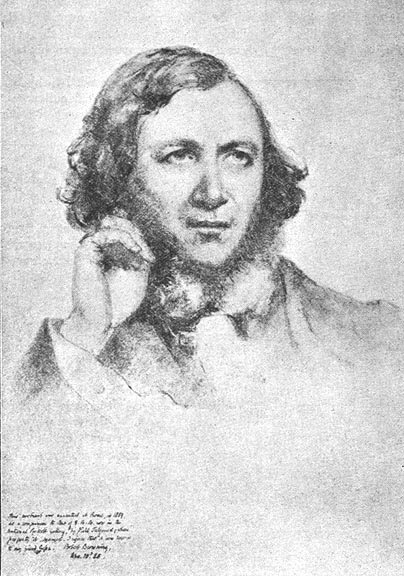
And now Robert is 200 and a day


“I love best the poets who hurt me. When in reading a poem I come across some line that thrusts itself into my heart — then is my soul knit unto the soul of that poet forevermore. Browning hurts me worse than any poet I have ever read — so I love him most.”

Lucy Maud Montgomery


"Or from Browning some 'Pomegranate,' which, if cut deep down the middle,
shows a heart within blood-tinctured of a veined humanity."

Elizabeth Barrett (1844)


There were a number of lovely tributes to Robert Browning for his birthday yesterday, but this one from Kimberly Eve at Musings of a Writer is especially notable for placing brief, introductory excerpts from his writings among relevant selections of art. I'd recommend it for those wanting a light first sample.


An interesting post from the blog of the University of Texas' English department led me to Max Beerbohm's caricature of Browning introducing a "lady of rank" to Rossetti. (Does that look like Lizzy Siddal dressed as a maid?)
Here's Robert and Elizabeth's correspondence on the 7th of May, 1846 and here are Emma Thompson and Stephen Fry making fun of the courtship that often seems more famous than the poets' literary accomplishments. (It's a little ways into the video, past a song and Hugh Laurie talking gibberish fluently.)

I've had a bad day, so I'm off to take comfort in "Rabbi Ben Ezra". I'm not sure that right now I truly believe "the best is yet to be", but the poem is long enough to provide comfort simply through its meter. (Today I've gone around repeating, "The count your master's known munificence is ample warrant that no just pretense of mine for dowry will be disallowed," just because the flow is yummy.)

So, readers, do you agree with Browning's optimism? What's your favorite Browning poem?

  • Digg
  • Del.icio.us
  • StumbleUpon
  • Reddit
  • RSS

A Letter to Robert Browning on his 200th Birthday


How do I love thee? Let me count the ways.
I love thee to the depth and breadth and height
My soul can reach, when feeling out of sight
For the ends of Being and ideal Grace.

(Elizabeth Barrett Browning, Sonnets from the Portuguese, XLIII )

Dear Mr. Browning,

I don't pretend to understand you perfectly. At the moment I can't remember if "Sordello" is a man, a city or a book. But I do want to count a few of the ways I love you.

I first became especially interested in you over a year ago during a time of discouragement and depression. Have you had a chance to read George Eliot's Armgart? Well, like Armgart, my sense of self became intertwined with my singing voice, and when I thought my voice might not amount to anything, I became depressed. But a line from your poem about "Andrea del Sarto" ("the faultless painter" who has essentially stolen money from his patron to satisfy his worldly wife) kept ringing in my mind, "Ah, but a man's reach should exceed his grasp, or what's a heaven for?" I read the whole monologue and the truths the painter expresses out of his pain and failure came to be a part of how I view art and ambition.

In this world, who can do a thing, will not;
And who would do it, cannot, I perceive:
Yet the will's somewhat--somewhat, too, the power--
And thus we half-men struggle.

In "Rabbi Ben Ezra" too you helped me recognize the presence of hope in apparent failure. When I'm discouraged and questioning the worth of my life and struggles, when I'm longing to choose the easy path, I remember lines like these:

Then, welcome each rebuff
That turns earth's smoothness rough,
Each sting that bids nor sit nor stand but go!
Be our joys three-parts pain!
Strive, and hold cheap the strain;
Learn, nor account the pang; dare, never grudge the throe!

For thence,—a paradox
Which comforts while it mocks,—
Shall life succeed in that it seems to fail:
What I aspired to be,
And was not, comforts me:
A brute I might have been, but would not sink i' the scale.

Thoughts hardly to be packed
Into a narrow act,
Fancies that broke through language and escaped;
All I could never be,
All, men ignored in me,
This, I was worth to God, whose wheel the pitcher shaped.


So, you see, I'm easily discouraged by myself, but there you are, loudly proclaiming through various characters what G. K. Chesterton saw as your first great theory, "the hope which lies in the imperfection of man." Perhaps your wife put it just as well in her most famous sonnet, noting that the soul reaches its greatest depths and heights when feeling the impossibility of ever becoming what it was created to be.

There are other things I love about you too. I love that in times when the foundations of English society were being challenged, when Tennyson was crying out in agony that he was "in infant crying for the light," you were declaring that you "prize[d] the doubt" and using that doubt as the basis for a vigorous faith that made you "ever a fighter".

I love your sense of fun, even when it may have a tragic lining. Someday, like the little American boy, I'll visit London and the "nabby where the man is ded that wrote the Pied Piper [sic]."

Rats!
They fought the dogs and killed the cats,
And bit the babies in the cradles,
And ate the cheeses out of the vats,
And licked the soup from the cooks' own ladles,
Split open the kegs of salted sprats,
Made nests inside men's Sunday hats,
And even spoiled the women's chats,
By drowning their speaking
With shrieking and squeaking
In fifty different sharps and flats.

Mr. Browning, you're a part of my life now. Yesterday as I recited My Last Duchess in the shower, my mother was afraid I was listening or talking to some modern device which would electrocute me. She really should have been afraid of the sinister character of the duke, revealed so subtly that every new reading gives a greater appreciation of your masterful art.

You've given me laughter, rhymes to run up and down the corridors of my mind, comfort in pain, rebukes in self-pity, faith in doubt, and countless sources of intellectual stimulation. A girl couldn't ask for much more.

Affectionately,

Sarah (aka Lit~Lass)


P.S. I hope you know what 'links' are, in case, after the passage of so many years, you're left saying, "I can't remember me own verses".


  • Digg
  • Del.icio.us
  • StumbleUpon
  • Reddit
  • RSS

April Reading Roundup

My family and are soon to "quit Norland", so I have an exceedingly busy week or two ahead which will probably keep me from posting for Browning's Bicentennial as I had planned. It's also cut the time I've devoted to writing a few of this month's reviews, so forgive their brevity.

In a Dog's Heart by Jennifer Arnold (nonfiction, audiobook, 7 ½ hours)

I'm posting this first because it is a Must Read for dog owners. Actually it's a Must Read for anyone who's ever going to be around dogs in any capacity, be it feeding the neighbors' dog while they're on vacation or having a child run towards a dog at the park.

With sections on feeding, training, first-aid and choosing a dog, it's a good first-time owner's handbook and will remind long-time owners of the responsibilities and privileges of dog ownership.

The author, Jennifer Arnold, is the founder of Canine Assistants, a foundation that provides service dogs for those with various disabilities. Her experiences provide numerous stories of the power of the canine-human connection and the astounding selflessness dogs have revealed in serving, rescuing and comforting humans.

But perhaps most valuable is Arnold's indictment of the Alpha-dominance training philosophy (popularized by Cesar Milan). Incidents of dog bites have risen as human's refuse to respect dog's indications of fear and pain (such as growling) and ascribe every behavior to a mistaken-belief in dogs' drive for dominance. Arnold presents a kind, yet balanced system of ethics to guide our relationships with dogs which cannot be ignored without further estrangement from a naturally beautiful partnership.

If only for her clear insights on how dog's minds work (hint: we've simplified them into dominance-hungry wolves), this book should be read by every dog owner. For its insights into how human's inadvertently cause “aggression” in dogs, this should be read by anyone who ever comes into contact with dogs. Real, genuine aggression in dogs, Arnold explains, “is so rare as to be statistically almost nonexistent.”

Lastly, the insights into the almost magical power of the human-canine bond, its benefits to humans,and what we owe animals, should make this required reading for every person who has ever wondered about animal's rights and their place in our world.

A Favorite Quote: "We must remember that dogs are not wolves; they are both our wards and our team-mates, but never our enemies. Our relationship [with dogs] compensates for our individual weaknesses as species and creates a whole vastly superior to the sum of its parts."


Jane Austen: A Life by Claire Tomalin (biography, 338 pages with notes which, yes, I did read)

In the first biographical work on Jane Austen (Henry Austen's biographical notice published with NA and Perusasion) it was declared “of events her life was singularly barren.” Just before chapter one, Tomalin quotes William and R.A. Austen-Leigh (I'm assuming they were James-Edward's sons) contradicting their great-uncle's words, “The uneventful nature of the author's life... has been a good deal exaggerated.” Well, the fact remains that with no surviving diaries and probably scores of letters burned, it's a little hard to write a really personal biography of Austen. (Though it's hardly discouraged dozens from trying.) But Tomalin has succeeded admirably. The work is scholarly without being pedantic and warm without romanticizing. I lapped up every drop of information on her family, her neighbors and her influences, but even less fanatical Janeites will find the depiction of life in the seventeen-and-eighteen-hundreds informative.

In a way the singular barrenness of event in Jane Austen's life and letters is one of the things that makes her my heroine. Her problems were ones that can still be mine – the pain of dependency, poverty, forced moves, and friction within the family. Jane Austen wasn't a “portrait of perfection” and sources don't leave us with a lot on her character, intellectual views, or spiritual struggles (besides the vague praise afforded posthumously by her brothers.) There are few instances of her performing morally-weighty actions, like her heroines, and her letters are almost determinedly light. Yet Tomalin gives us enough of a glimpse into her character for her to be even more one of my heroines than her heroines are – her kindness to the poor and aged and special interest in servants and dependent women.

Jane Austen's family certainly had imperfections to match any in the novels, and were sometimes quite thoughtless about her feelings and needs. Yet her love for them shines through the poems and letters she sent and I think there actually is something to the statement that she had “a temper that did not require regulation”. (Paraphrased)


A Favorite Quote: On the last page I must return to Jane Austen herself. To the child, for whom books were a refuge, offering a world that sometimes made better sense than the one she had to find her way about. To the girl whose imagination took off in startling directions as she began to see the possibilities of telling stories of her own. To the energetic young woman who loved dancing and jokes, and dreamt of a husband even as she apprenticed herself to novel writing with all the force of her intelligence. To the 25-year-old who decided she did not like people and could not write anymore; and who was tempted to make a comfortable, loveless marriage, and put the temptation behind her. To the loving sister and aunt who always made time for her family even though she would sometimes have preferred to be left to think and write in peace. To the woman who befriended governesses and servants. To the published author in the glow of achievement and mastery of her art. To the dying woman with courage to resist death by writing in its very teeth. To the person who on occasion preferred to remain silent rather than cut across the views and habits of those she loved; and who kept notes of what people said about her work, to read over to herself. This is my favorite image of Jane Austen, laughing at the opinions of the world. It is lucky she had so much laughter in her; today, the volume of opinions has swelled to something so huge that they could be laughed at forever.”


Elizabeth the Queen by Alison Weir (biography, 488 pages)

I don't know exactly why I'm fascinated by Elizabeth, but this biography amply showed her many extraordinary admiral qualities, which providence indeed seemed to have given her “for such a time as this.” Yet the book provided a few laughs at Elizabeth's constant capriciousness and prevarication as she played the marriage game. Genealogical charts made me more clear on Tudor-era names I'd frequently heard. I just wish I owned it, since its many details may be too soon forgotten.


The Story of the World, Volume 1: Ancient Times From the Earliest Nomads to the Last Roman Emperor by Susan Wise Bauer (history, audiobook of 8 hours)

This is a children's history, so I probably wouldn't have read it if it weren't on audiobook. However, I don't mind hearing a few explanations of words and concepts I fully understand while making bread or exercising. While I'm a history buff, I've tended to focus on certain places and time periods (such as the Reformation, or Victorian England) so it was fascinating to hear about ancient Egypt, Greek myths, and the Roman stories behind words and phrases we still use in modern English.


Elizabeth I by Margaret George (historical novel, audiobook of 31 hours)

Beginning with the threat of the coming Armada, and focusing on only the last third of Elizabeth's reign, this might also be appropriately titled The Rise and Fall of the Earl of Essex. While I always felt distanced from the first-person narration of Elizabeth, perhaps that was intended, since royalty of Elizabeth's mettle is enigmatic. I especially enjoyed the narration of Lettice Knollys, Elizabeth's cousin and Essex's mother, juxtaposed against Elizabeth's. Lettice's character at first seemed hard and calculating, but both she and Elizabeth mellowed subtly over the course of the long novel. The book also contains enjoyable cameos of Shakespeare, Donne, Spencer and other great men of the age.


The Scarlet Letter by Nathaniel Hawthorne (novel, 221 pages without introduction)


I looked forward to reading this novel, but didn't expect to be so exceedingly entranced by its vibrancy and power. In accordance with my sympathy for anti-heroes, I have to confess Dimmesdale is probably my favorite character. George Eliot explains it well, “That is a rare and blessed lot which some greatest men have not attained, to know ourselves guiltless before a condemning crowd... The pitiable lot is that of the man who could not call himself a martyr even though he were to persuade himself that the men who stoned him were but ugly passions incarnate – who knows that he is stoned, not for professing the Right, but for not being the man he professed to be.”


Planned Reading for May Includes:
Lady Susan
(reread)
Sense and Sensibility (reread)
Eden's Outcasts by John Matteson
Uncle Tom's Cabin


  • Digg
  • Del.icio.us
  • StumbleUpon
  • Reddit
  • RSS

Browning Bicentennial Events and Browning-related Reading

"It may be apocryphal but it was said that General Allenby, in the middle of the campaign against the Turks in 1917, was rushing about his quarters, visibly flustered. 'Where's my Browning?' he demanded of his ADC. 'It's in your holster, sir', came the answer. 'Not the Browning revolver, I meant Robert Browning,' roared Allenby."

This anecdote comes from the first commenter on a recent Telegraph article encouraging us to celebrate Robert Browning's bicentennary "with loud, cheerful and sometimes discordant music."

Here's the Browning Society's roundup of events (unfortunately mostly in Britain) throughout the year.

This link includes a few events in the U.S. Unfortunately nothing is close enough for this Browning devotee to attend.

Browning Related Books

Plans for my Browning Week (hosted here) are changing a little due to my busy schedule, and will consist mostly of posts on some of the poems. (Though I'd love to find someone to guest blog on Browning.) I do hope to do some reading about Browning which will hopefully extend through the whole year. Here's a list of books I might read and that might be of interest to anyone wanting to acquaint themselves with Browning.

Biographies (I really need to do some research, because I have no idea which of the following biographies are the best.)

Forever in Joy: The Life of Robert Browning by Rosemary Sprague (167 pages)


Two Poets, a Dog, and a Boy by Theresa Russel

The title seems to indicate it must be about the Brownings' life in Florence


Robert Browning : A Life After Death by Pamela Neville-Sington

Don't worry! It's not spiritualistic – that was Elizabeth's problem – it's about Browning's life after her death. I'll admit this is the bio I'm most inclined to because it has a nice cover and is the most recent. Superficial, I know.


Fiction/Drama

Flush by Virginia Woolf (fiction, 110 pages)

This biographical novel about Elizabeth Barret Browning's dog undoubtedly includes Robert. Because I'm a dog-lover, have had it out from the library before, need to read more Woolf, and included it in my Classics Club list, I hereby vow to read this book, if I read no others.


The Barretts of Wimpole Street by Rudolph Besier

I used to be quite disdainful of the popularization of people as formidably intellectual as the Brownings, but now I think 92 pages of this might not hurt. Besides, I don't read enough drama.


Criticism

Robert Browning by G.K. Chesterton

Apparently this is a combination of biography and criticism. I've gained the impression that Chesterton was one of Browning's warmest admirers and ablest critics. I might listen to it from LibriVox.

Robert Browning by Robert B. Pearsall

A Twayne's critical guidebook that I read parts of earlier in the year. It's not bad, but I'd probably only finish to because of my OCD need to actually read books in full.

Faith of Robert Browning by Hugh Martin

I really can't find any information about this book that I found in the library archives, but since Robert Browning's faith is one of the things I love most about him, I might check it out.

Browning as Philosophical and Religious Teacher by Henry Jones

An online (1890) book I stumbled across, and which looks interesting, despite my inability to learn anything about the author.

His Own Works

The Complete Poetical Works of Browning

I really am not going to try to read approximately 1000 pages, but I may try to get through The Ring and the Book and read whatever else catches my eye.

I'll probably listen to a Naxos AudioBooks 80 minute recording of some of the notable poems. I don't like short verse, such as Emily Dickinson's, read, but I think a good reading could enhance my understanding of some dramatic monologues.

The Brownings: Letters and Poetry (edited?) by Christopher B. Ricks

I don't think this is the couple's full correspondence, but it might be a treat to read some of it.


If anyone knows of any good biographies or would like to contribute to this blog's celebrations of Robert Browning, please don't hesitate to comment.


  • Digg
  • Del.icio.us
  • StumbleUpon
  • Reddit
  • RSS

Reading Louisa May Alcott in March

-->

I mentioned in my March Reading Roundup that my thoughts on Susan Cheever's biography of Louisa May Alcott and my thoughts on another reading of Alcott's Rose in Bloom had become rather lengthy. As promised, here's a post on both books, though I fear my ramblings on possible intertextuality in Rose in Bloom are long and indecisive.
Louisa May Alcott: A Personal Biography by Susan Cheever
As a biography I think this work could be considered a little disjointed. Months and years in Alcott's life are rushed through in a few un-detailed sentences, while narrative is sometimes interrupted for dissertations on history, genius or feminism. But maybe I'm just too curious about the things only hinted at, such as Louisa's acting “career” or her relationships with her sisters. I certainly did appreciate the historical context that the book provided as well as Cheever's value for Alcott's intelligent feminism.
The preface is a paean to Little Women as a guide through the “morass of feminine questions”, such as: “How can a woman avoid the trap of dependence and still have family satisfactions? [And] how can she enjoy the rich satisfactions of good work and earning money without missing out on a domestic life?” Since this theme in Alcott's works is one that especially makes her one of my heroines, I thoroughly appreciated the preface and the similar treatment of the novel An Old-Fashioned Girl.
I know some have been disturbed by such things as Cheever's conjecture that Bronson Alcott may have sexually abused his daughters. Certainly there is not enough evidence to make a decent argument for this, but Alcott's eroticization of the father-figure in such works as the thriller A Marble Woman or The Mysterious Model makes me more interested than incensed by the unprovable suggestion.
It was the epilogue that I found most thought-provoking. “Tell me she had a happy life!” a woman pled when she heard Cheever was writing a biography of Alcott. From the overall tone of the book, (with its accounts of numerous illnesses and conjecture that Louisa might have been bipolar,) I expected Cheever to say no. “What I think but don't say,” Cheever writes, “is that Louisa May Alcott had a happy life but that she had something even more important – a life and a body of work that are still fresh and enlightening today.”
My own Protestant upbringing has taught me that happiness isn't to be one's goal in life, but the underlying message has been that happiness will be the result of godly living. As an ambitious woman, I also understand what Cheever is saying about lasting work, rather than “happy days" spent doing ephemeral things. But according to modern or feminist ideals, isn't work - especially creative work - supposed to bring a fulfillment we automatically (but perhaps mistakenly) equate with happiness? While Alcott was undeniably a supporter of women's rights, perhaps Cheever is missing the need for domestic happiness present in some of Alcott's most independent heroines, such as Polly Milton or Phebe Moore (more on the Moore girl later).
A pathetic quote from 1874 reminds us how much more complicated real life was for the famous authoress than for her fictional heroines: “When I had the youth I had no money, now I have the money I have no time, and when I get the time, if I ever do, I shall have no health to enjoy life.” It was largely due to her role as financial and emotional provider for “the pathetic family” that Alcott was deprived of health and time. Yet “Alcott's life was what she made it, what she chose,” Cheever reminds us. “From the beginning she hoped to support her family; she did. From the beginning she aimed to have a voice in the world; she did.”
Rereading Rose in Bloom I was reminded of the importance of “the gift of living for others”. Certainly this was prominent among Louisa May Alcott's many gifts. Perhaps Cheever has a tendency to underestimate the joy Alcott received from serving others and the reciprocal way her family cared for her. Susan Bailey recently reported on some thoughts expressed by Jan Turnquist, executive director of Orchard House: “She pointed out that Louisa’s family was always there for her and knew exactly how to take care of her when she needed them most. Whether it was nursing her back to health after her stint as a Civil War nurse, or respecting her moods and needs to be alone to write (as evidenced by Louisa’s use of the 'mood pillow'), Louisa received as much as she gave.”
In conclusion, while I'm glad I read this book, I can't wait to read more biographies of Louisa May Alcott, so I can get various perspectives and form my own portrait of one of my heroines.
A Favorite Quote: “They [the Alcotts] might starve, but they would starve as gentlewomen and as intellectuals, as farmers who revered the land or teachers who understood Plato, not as illiterate millworkers or factory girls.”

Thoughts on Rose in Bloom by Louisa May Alcott (May Contain Spoilers)
I was eight years old when I was first given a copy of Rose in Bloom. It introduced me to nineteenth century novels and the marriage plot. A marriage-plot-novel the book may be, but Rose Campbell is a “strong-minded” woman who has vowed not to “have anything to do with love” till she has proved she is “something besides a housekeeper and a baby-tender!” Of course, as a rich heiress in fashionable New England, keeping to that resolve proves difficult. But she has her Uncle Alec to help, just as she did in childhood; indeed, Rose's continued dependence on the father-figure has disturbed some modern readers. Personally, I'm adamantly against ideologies, like Christian Patriarchy, which, in the words of Susan B. Anthony, “ordain all men sovereigns, all women subjects”. But I'm still not sure that I consider Rose's reliance on Uncle Alec as more than a healthy relationship of youth being counseled by the wisdom of experience. I'll hold off judgment on that aspect till a future rereading.
I do know that I'm uncomfortable with the treatment of Phebe Moore. Phebe's story is begun in Eight Cousins when Rose decides to “adopt” the sweet, musical orphaned kitchen-hand from the poorhouse. In Rose in Bloom Phebe is an accomplished singer who earns her bread (and reputation) far from home in the big city. Yet she still refers to Rose as “little mistress” and wants to “make some sacrifice” for her. In an article on Henry James' review of Eight Cousins Edith Gilmore provides something of an explanation for Alcott's subservient placement of Phebe: “Alcott never does work out some confusion about the advantages of coming from 'fine old stock' as compared to a nowhere origin like Phebe's. Although we are told that Phebe's hardships have formed her courageous character, it is evident that Alcott sympathizes with Rose's pride in her lineage and likes the concept of Rose as the flower of an ancient stem.”
But I'm even more troubled by the implication that Phebe must give up her singing career and sing for her husband alone when she marries. Actually, the sacrifice is natural in the nineteenth century context, but it's the treatment of it that disturbs me. (Jenny Lind did some concerts and became a professor of singing after her marriage, but one feels that it was not only her fame that made the difference, but the fact that her husband was a musician and composer who worked with her. Fine as the man may be who marries Phebe, one feels that he would be looked down on if he gave up his business to be close to her while she devoted her energies to her art.) From the beginning Phebe's art is presented as being an aid to domesticity; we first hear her singing in Eight Cousins as she scrubs floors. Later, Archie falls more in love with her while she and Rose sew and sing. Her debut as a singer is at a charity concert for orphans, with whom she identifies herself. “I never shall … think my music lost if it makes home cheerful for my mate,” she finally declares. “Birds sing sweetest in their own nests, you know.”
This view of art as an aid to domesticity is in direct contrast to that of George Eliot's singing heroines - Armgart and Princess Halm Eberstein. Armgart, the eponymous heroine of Eliot's verse-drama, refuses a marriage proposal, declaring, “The man who marries me must wed my Art —Honour and cherish it, not tolerate.” Princess Eberstein, in Daniel Deronda, gives up a child to further her career and only remarries (and gains that ridiculous title) when she thinks she has lost her voice.
Whether or not Alcott was aware of Eliot's singing heroines, Phebe ends up looking like the Jewess Mirah who maintains incredible simplicity, eschews the theatrical and is characterized by her devotion to the men in her life, rather than to her art.
As an amateur singer myself, I feel like my voice is “my letter to the world that never wrote to me”. To have it proposed that one stop singing publicly is like damming up the springs of the soul. “I love in singing, and am loved again,” Armgart says, leading her friends to conclude that in losing either her voice or the instinct behind it, they “should lose that whole [they] call [their] Armgart.” I am not my voice, but my voice is myself.
I tend to think Louisa May Alcott may have granted Phebe a little more of the autonomy of her voice if her art was closer to Louisa's own. While Jo March eventually submerges authoress in wife and mother, I have more of an impression of her intimate connection with her art.
Conclusion? I don't have one, except that here is another instance of the inevitable war between female ambition, intellectuality, desire, domesticity and religion that always leads me back to Christina Rossetti's inability to say “enough on earth”.

Now on to a different tack - SPOILERS FOLLOW

My favorite chapter in Rose in Bloom is “Among the Haycocks”. I like it despite the fact that every time I read it I feel guilty for not being more familiar with Keats, Milton, Emerson and Thoreau. Since it's full of literary references, I decided to take a look at what some might mean in the context of the story. I think the abundance of quotes by Emerson and Thoreau are self-explanatory to anyone who understands Louisa May Alcott's adoration for the men themselves and immersion in their philosophies. Therefore I'll put forward what I think may be the possible meanings of the other references; of course, I could be entirely wrong, or at least reading too much in. What can I say? I've loved this novel too long.
"'The Eve of St. Agnes' is the most perfect love story in the world, I think," Mac says, as he reads Keats' medieval story to Rose. Since the chapter is really the beginning of the cousins' love story, I think the inclusion of the poem is significant. The poem begins with a world of silence, desolation and “bitter chill”. Even when we enter the castle revelries, where the maiden Madeline is, we discover she is detached from her suitors and all that is going on around her. This parallels Rose's detachment in the fashionable world she has recently participated in, and indeed the situation of virtually all heroines of nineteenth century novels. Although Madeline plans to follow the tradition that is said to reveal to a girl her lover on St. Agnes' Eve, we see no evidence that she is thinking of Porphyro, who comes of an enemy family, and has entered the castle with the help of an old servant. Perhaps this parallels the fact that Rose has not thought of Mac in that way. In the next chapter of the novel, Rose is awakened to Mac's love only when he declares it; she initially rejects him, but it is the expression of his eyes that slowly woos her; she accepts his love after he has become a poet. Similarly, Madeline (literally) awakens to find Porphyo's gaze on her as he sings and plays her lute.
It seems that while Louisa May Alcott was a feminist, she portrayed (in this novel, at least) a rather traditional view of enclosed (or even imprisoned) female existence, with the male gaze as an agency in awakening love.
Perhaps a more hopeful paradigm for Rose is when Mac compares her to the nymph Sabrina in Milton's masque Comus. While she has already played the part of the Lady tempted by intemperance (Charlie's weakness and intemperance at frivolous balls) and illicit sexuality (flirting, risque novels and a marriage without respect) she has, like the Lady, repel[led] interference by a decided and proud choice.” But comparing Rose to the nymph, Sabrina, who rescues the Lady when her brothers' efforts have failed, may imply that she has attained (spiritual) power and is now an example and aid to other tempted maidens. (I think my thoughts on this were better when I was first reading about Comus, but I forgot them.)
Well, do you think I've over-analyzed an obscure 19th century book?

  • Digg
  • Del.icio.us
  • StumbleUpon
  • Reddit
  • RSS

March Reading Roundup

Great Expectations by Charles Dickens (fiction, audiobook)

This is my favorite Dickens novel yet. I positively adore it and it has certainly earned its place in my Top Ten list. From beginning to end it is riveting. Pip's discontent with his lot and later behavior to his friends may be reprehensible, but Dickens makes it understandable. Next time I read it, I want to look at as a kind of Condition of England Novel - showing, perhaps, the discontent of youth in the lower classes, the apathy of the upper classes and the conditions that lead to crime. Abel Magwitch is delightfully ironic – both in his own perspective on his relation to Pip and in how I as reader am led to vacillate in my sympathy for him and disgust with Pip's disgust for him. Ultimately I don't know how anyone can not be made better by how the novel broadens our sympathies. The novel can be gothic, and no author but Dickens could so successfully immortalize Miss Havisham's wedding cake, but it's also a storehouse of chortles. (My favorite, at present, being Wemmick's wedding, placed in a patch of Dickensian sentimentality.)

A Favorite Quote: When we had fortified ourselves with the rum-and-milk and biscuits, and were going out for the walk with that training preparation on us, I was considerably surprised to see Wemmick take up a fishing-rod, and put it over his shoulder. "Why, we are not going fishing!" said I. "No," returned Wemmick, "but I like to walk with one."

I thought this odd; however, I said nothing, and we set off. We went towards Camberwell Green, and when we were thereabouts, Wemmick said suddenly:

"Halloa! Here's a church!"

There was nothing very surprising in that; but a gain, I was rather surprised, when he said, as if he were animated by a brilliant idea:

"Let's go in!"

We went in, Wemmick leaving his fishing-rod in the porch, and looked all round. In the mean time, Wemmick was diving into his coat-pockets, and getting something out of paper there.

"Halloa!" said he. "Here's a couple of pair of gloves! Let's put 'em on!"


Louisa May Alcott: A Personal Biography by Susan Cheever (nonfiction, biography, around 275 pages, I listened to some of this as an audiobook and read some in print)

Some of my thoughts on this became rather lengthy, so I'll be making a separate post on my Louisa May Alcott reading of the month.

A Favorite Quote: “They [the Alcotts] might starve, but they would starve as gentlewomen and as intellectuals, as farmers who revered the land or teachers who understood Plato, not as illiterate millworkers or factory girls.”


Rose in Bloom by Louisa May Alcott (reread for about the fourth time, 311 pages, fiction)

Again, my thoughts on possible intertextuality in one of my favorite novels became rather lengthy, so will be included in the Louisa May Alcott reading post.


An Interesting Quote: "Not in words did the resolve shape itself, but in a quick impulse, which she obeyed - certain that it was right, since it was hard to yield to it." To my understanding, this is an interesting description of the combined Romanticism and stringent attention to character of Transcendentalism. What do you think, reader?


The Friendly Jane Austen by Natalie Tyler (nonfiction, around 280 pages)

There are some silly (non-capital 's') things in the book, such as its ratings of characters with Es for Elton vulgarity. But it also has some treasures not in every other 'introduction' to Austen - plenty of fabulous quotes I just had to copy, interviews with many Janeites, and historical information on everything from the Thorpe's favorite word "quiz" to the ingredients of Bingley's white soup.

From an interview with Captain Phoebe Spinrad (“a highly decorated veteran of the Vietnam War”) which condemns Mrs. Bennet for “teaching her … daughters... that sleeping around is a good way to catch husbands...” and commends Sir Thomas Bertram for “responsibility”, to Edith Lank's theory on Harriet Smith's parentage, it made me think and laugh... like Jane Austen does.


Lives Like Loaded Guns: Emily Dickinson and Her Family Feuds by Lyndall Gordon (biography/history)

I listened to much of this as an audio book, but had to send it back to the library while I was in the final chapters. I'm going to finish it (in book form) later this month and will perhaps review it then. It was thoroughly absorbing and even frightening. I mean that there's something of Emily Dickinson's own feeling "as if the top my head were taken off" when you're plunged into a world where the Bronte's heroes and heroines were striding the moors, Elizabeth Barret Browning was crying, "Go from me!", George Eliot had let Maggie Tulliver run away and Christina Rossetti was longing for someone to fill and take her. And then there was my Eternal Emily Dickinson creating Infinity. I fell into a vortex of the Indescribable while washing dishes. (And, yes, I fell into strange punctuation and capitalization.)


Life Without Parole by Rick Fleck (nonfiction/autobiography, 248 pages)

Rick Fleck grew up in a dedicated Christian family in Alberta, so some of my friends and acquaintances know him and his family personally. Unfortunately, Rick didn't have a personal relationship with Jesus, so he became rebellious and developed habits that led to a mad cycle greed and addiction. Finally his wrong choices caught up with him, and he was accused and convicted of a murder he did not commit. He received a life sentence and has experienced the horrors of maximum-security prison life, with demeaning treatment and (frequent) brutal race riots. But he's also experienced the glory of God's nearness in the worst situations, because shortly into his prison experience, God was finally able to reach him.

I appreciated that (unlike a book about a drug-dealer-turned-Christian that I read last year) he showed how he'd developed habits that led to deceit and addiction, but didn't feel the need to confess every sin he'd ever committed to the wider public. Although I would never think twice about taking any kind of drug, I gathered from the book the importance of not allowing any behavior to take on an addictive nature. (Be it bloghopping or late night snacks ;) Fleck's book was an inspiring and fascinating testimony to the power of God to save to the uttermost and keep under the shadow of His wing.


Short Story: “The Yellow Wallpaper” by Charlotte Perkins Gilman


Susan Bailey mentioned this story in connection with an interesting post she made on the "rest in a dark room" cure prescribed for Mac in Eight Cousins. I knew of the story from The Madwoman in the Attic and am glad I finally read it. A few of my thoughts on the story are in the comments of Susan's post.


  • Digg
  • Del.icio.us
  • StumbleUpon
  • Reddit
  • RSS

Anne of Green Gables Questionnaire

This is a questionnaire tag by Miss Dashwood for her Anne of Green Gables Week (see the link in my side bar). I'm always delighted to celebrate the Anne-girl and my beloved Lucy Maud Montgomery in any way, so here are my answers.

  1. How many of the Anne books have you read, and how many of the films have you seen?

    I've read every one of the books, some repeatedly. (Unless you count that there are a few short mostly-not-about-Anne stories in The Blythes are Quoted that I haven't read yet. That's a book of short stories which is not part of the series, but mentions the Blythes a few times, for the information of the uninitiated.) But I've only watched the first film. I'm a purist. It gets my ire up to hear how much the story was changed in the sequels.

  1. If someone yanked your hair and called you carrots, what would you do to him?

    I'd remember that I have raven black hair and an alabaster brow and my name is Cordelia, so why should I notice lowly, prosaic and unromantic schoolboys? Seriously, I'd probably go Ilse Burnley (minus the temper) and call him names he couldn't understand. “You troglodyte and nefarious miscreant! I will defenestrate you with obloquy.”Ah, Ilse does it better.


3. What would you do if Josie Pye dared you to walk the ridgepole of a roof?

I'm very much afraid I would do it. :( I have reputation to maintain, though I can't say precisely what it is.


  1. If you had the opportunity to play any AGG character in an AGG play, which role would you choose?

    Not to be vain, but I've been told I look like Anne and have her imagination. Though I'd really like to be Miss Cornelia Bryant and be able to say, “Isn't that like a man?” every few paragraphs/minutes.


  1. If you were marooned on a desert island, which AGG character would you want to have as a companion? (Anne, Gilbert and Diana are not options. Let's keep this thing interesting. Not that they're not interesting.... oh, yay, now the disclaimer to this question is longer than the question itself. Lovely lovely lovely.)

    Lol. Dare I take a moment to commit treason and say I've never found Diana interesting? Ilse Burnley (of the Emily trilogy) gets my vote for best friend. Okay. Maybe I'll take Susan Baker. She could make me some very yummy food, would be utterly loyal and would chase away Whiskers-on-the-Moon if he ever dared come near our island. Or maybe Paul Irving and his imagination would be the best companions. Or maybe lively, capricious Philippa Gordon. Can't I just take all the Island people?


  1. If there was going to be a new adaptation of the Anne books and you could have any part in making the movie, what would you choose to do? (screenwriting, acting, casting, costume-making are a few possibilities)

    Screenwriter, I guess. Because much as I love film, I'm ultimately a purist to whom the text is everything, and is to be kept inviolate.


7. What are, in your opinion, the funniest AGG book/movie scenes? (choose one from the books and one from the movies)

I haven't watched the movie in years. :( The GREEN hair is wonderful in both! Anne's apology to Mrs. Lynde is a thing of beauty! How about Anne falling half-way through a roof in Anne of Avonlea? Miss Dashwood's answer reminded me of the wonderful “scene” in Anne of Windy Willows where she babysits two creatures from hell. “Miss Cornelia Makes A Startling Announcement” always has me in stitches. And I was just reminded of poor Rilla Blythe having to carry a CAKE through town (oh the disgrace!) I could go on for eternity. Lucy Maud, you are the joy of my life! So it was supposed to be ONE scene, by Gog and Magog!


8. What are, in your opinion, the saddest AGG book/movie scenes? (choose one of each again)

Really, it's been too long since I watched the movie to say anything on that. While Matthew's death is probably saddest it's the relationship between Anne and Marilla that's most touching - Anne giving up her plans to be with Marilla and Marilla acknowledging how much Anne means to her. As Margaret Atwood has pointed out, Marilla is the one who changes more than Anne. It's unromantic Marilla who actually has the fairy-tale transformation.

It's been ages since I've read Rilla of Ingleside but I remember growing to love Walter a lot, so I must have been pretty sad about his death. I think I found Una's quiet grief especially touching.


  1. Which AGG character would you most like to spend an afternoon with? (again, Anne and Gilbert and Diana are not options for this one--think secondary characters)

Spending an afternoon with Miss Lavender at Echo Lodge would be like spending an afternoon in fairyland, but I'd also be content with an afternoon in the kitchen of Susan Baker or Rebecca Dew.


  1. What is your definition of a kindred spirit?

    Someone with whom you can be comfortably silent, but to whom you can say whatever comes into your head, no matter how fanciful, or ridiculous it would appear to those not of the race that knows Joseph. A kindred spirit must have loyalty, grit, gumption, high ideals and a sense of humor.


Well, I'm reminded how desperately I need to reread the whole series! Here's to the Anniest of Annes!

  • Digg
  • Del.icio.us
  • StumbleUpon
  • Reddit
  • RSS

My Classics Club List


Jillian at A Room of One's Own recently came up with the bright idea of a Classics Club to "link together the bloggers who blog classics voraciously". She recommends listing a minimum of 50 classic books that you plan to read within five years. I've chosen 125 classic works, mostly from the Western canon, and including poetry, plays and novellas. My list starts with all the novels in Susan Wise Bauer's The Well-Educated Mind. (I'd originally listed "read all the books in WEM" as a goal in my 101 in 1001 list, but then realized that with roughly 150 titles in the book, that might be impracticable if I wished to read anything else.) With the other titles in my classics list, I've tried to go more with books I've wanted to read (or reread) for a while, rather than books I know I should read. However, the list is subject to change at any time.

I'm setting my completion-goal date as March 12, 2016. However, this too is subject to change if I find that that ugly beast Real Life is keeping me from reading as much as I would like.

I guess I'll "reward" myself with a nerdy t-shirt from CafePress when I reach 63 books and maybe the same when I reach the end of the list.

Rereads are in red.

The Well-Educated Mind Novel List


Don Quixote by Miguel De Cervantes

The Pilgrim's Progress by John Bunyan (I know it so well I may not reread it, though I love it, but replace it with The Holy War.)

Gulliver's Travels by Jonathon Swift

Pride and Prejudice by Jane Austen (I'm in no danger of not rereading this!)

Oliver Twist by Charles Dickens

Jane Eyre by Charlotte Bronte (I'm in no danger of not rereading this – I reread it at least once a year!)

The Scarlet Letter by Nathaniel Hawthorne

Moby Dick by Herman Melville

Uncle Tom's Cabin by Harriet Beecher Stowe

Madame Bovary by Gustave Flaubert

Crime and Punishment by Fyodor Dostoyevsky

Anna Karenina by Leo Tolstoy

The Return of the Native by Thomas Hardy

The Portrait of a Lady by Henry James

Huckleberry Finn by Mark Twain

The Red Badge of Courage by Stephen Crane

Heart of Darkness by Joseph Conrad

The House of Mirth by Edith Wharton

The Great Gatsby by F. Scott Fitzgerald

Mrs. Dalloway by Virginia Woolf

The Trial by Franz Kafka

Native Son by Richard Wright

The Stranger by Albert Camus

1984 by George Orwell

Invisible Man by Ralph Ellison

Sieze the Day by Saul Bellow

One Hundred Years of Solitude by Gabriel Garcia Marquez

If on a winter's night a traveler by Italo Calvino

Song of Solomon by Toni Morrison

White Noise by Don Delillo

Possession by A.S. Byatt


Other Well-Educated Mind Titles

Grace Abounding by John Bunyan

Walden by Henry David Thoreau

A Vindication of the Rights of Woman by Mary Wollstonecraft

Richard III by William Shakespeare

The Iliad by Homer

The Odyssey by Homer

The Canterbury Tales by Geoffery Chaucer

The Sonnets by William Shakespeare

Paradise Lost by John Milton

Essays by Michael de Montaigne

The Life of Saint Teresa of Avila by Herself

Up from Slavery by Booker. T. Washington

The Souls of Black Folk by W.E.B. Du Bois

Queen Victoria by Lytton Strachey (more for my very big and devastating love for Carrington than for Queen Vicky or even “that disgusting old man”.)


The Sort-of-Alphabetical List


The Holy Bible – King James Version (What do you mean the alphabet doesn't start with 't' or 'h' or 'b'? I was taught you should never put any book on top of the Bible – in the physical sense.)

Atwood, Margaret – The Handmaid's Tale

Alcott, Louisa May – Hospital Sketches

Alighieri, Dante - The Divine Comedy

Bronte, Charlotte – Shirley

Bronte, Charlotte – Villette

Browning, Elizabeth Barrett – Aurora Leigh (have to look up if it's actually long enough to qualify under books)

Burnett, Frances Hodgson – The Secret Garden

Burney, Fanny - Evelina

Cædmon - (His hymn/creation account)

Coleridge, Samuel Taylor – The Rhyme of the Ancient Mariner

Collins, Wilkie – The Woman in White

Dickens, Charles – A Tale of Two Cities

Dickens, Charles – Little Dorrit

Dickens, Charles – Nicholas Nickleby

Dickens, Charles - David Copperfield

Dickens, Charles – The Old Curiosity Shop

Dostoyevsky, Fyodor - The Idiot

Doyle, Sir Arthur Conan – The Hound of the Baskervilles

Eliot, George – The Mill on the Floss

Eliot, George – Daniel Deronda

Eliot, George – Silas Marner

Eliot, George – Romola

Eliot, George – Adam Bede

Eliot, George – Felix Holt, the Radical

Eliot, T.S. - The Wasteland

Emerson, Ralph Waldo – Essays (first and second series)

Faulkner, William – As I Lay Dying

Forster, E.M. - A Room with a View

Fuller, Margaret - Woman in the Nineteenth Century

Gaskell, Elizabeth – Mary Barton

Gaskell, Elizabeth – Life of Charlotte Bronte

Gaskell, Elizabeth – Ruth

Gaskell, Elizabeth – North and South

Gaskell, Elizabeth – Sylvia's Lovers

Gilbert and Gubar – The Madwoman in the Attic (yes, criticism, but pretty classic criticism that I keep meaning to finish.)

Fielding, Henry – Tom Jones

Hardy, Thomas – Tess of the D'Urbervilles

Hardy, Thomas – The Mayor of Casterbridge

Hugo, Victor – Les Miserables

Huxley, Aldous - Brave New World

Ishiguro, Kazuo – The Remains of the Day

Johnson Samuel - Rasselas

Lewis, C.S. - The Chronicles of Narnia

Lewis, C.S. - Mere Christianity

Milton, John - Comus

Milton, John - Areopagitica

Milton, John - Paradise Regained

Mitchel, Margaret – Gone with the Wind

Montgomery, Lucy Maud - Anne of Green Gables Series (reread eight novels and complete one book of short stories)

O'Connor, Flannery – Wise Blood

Orwell, George – Animal Farm

Pepys, Samuel – Diary

Pope, Alexander - The Rape of the Lock

Pizan, Christine de - The Book of the City of Ladies

Radcliffe, Anne – The Mysteries of Udolpho

Richardson, Samuel - Clarissa

Richardson, Samuel - Sir Charles Grandison or Pamela

Scott, Sir Walter – Ivanhoe

Shakespeare, William – King Lear

Shakespeare, William - Othello

Shakespeare, William – Macbeth

Shakespeare, William – Henry V

Shaw, George Bernard - Pygmalion

Shelley, Mary – Frankenstein

Spenser, Edmund - The Faerie Queene

Stoker, Bram – Dracula

Thackeray, William – Vanity Fair

Tolstoy, Leo – War and Peace

Virgil – The Aeneid

Wallace, Lew – Ben Hur

Waugh, Evelyn – Brideshead Revisited

Whitman, Walt – Leaves of Grass

Wilde, Oscar – The Picture of Dorian Grey

Wilde, Oscar – The Importance of Being Earnest

Woolf, Virginia – Orlando

Woolf, Virginia – Flush

Woolf, Virginia – A Room of One's Own

Novellas and Poetry

In Memoriam by Alfred, Lord Tennyson

Goblin Market by Christina Rossetti

The Lifted Veil by George Eliot (novella)

The Metamorphosis by Franz Kafka

And a dreadful prognostication on the best laid plans of those who may, or may not, be handsome, clever and rich:

"Emma has been meaning to read more ever since she was twelve years old. I have seen a great many lists of her drawing-up at various times of books that she meant to read regularly through--and very good lists they were--very well chosen, and very neatly arranged--sometimes alphabetically, and sometimes by some other rule. The list she drew up when only fourteen--I remember thinking it did her judgment so much credit, that I preserved it some time; and I dare say she may have made out a very good list now. But I have done with expecting any course of steady reading from Emma. She will never submit to any thing requiring industry and patience, and a subjection of the fancy to the understanding."


  • Digg
  • Del.icio.us
  • StumbleUpon
  • Reddit
  • RSS